
Responsible Gambling: Limits, Self-Exclusion and Where to Get Help
How to keep betting under control, the tools licensed bookmakers must offer, self-exclusion options and the free National Responsible Gambling Programme helpline.
Responsible gambling means betting only with money you can afford to lose, for a limited time, and stopping when it no longer feels like entertainment. If you are worried about your own betting or someone else's, the National Responsible Gambling Programme offers free, confidential counselling 24 hours a day, seven days a week on 0800 006 008, or by SMS or WhatsApp on 076 675 0710.
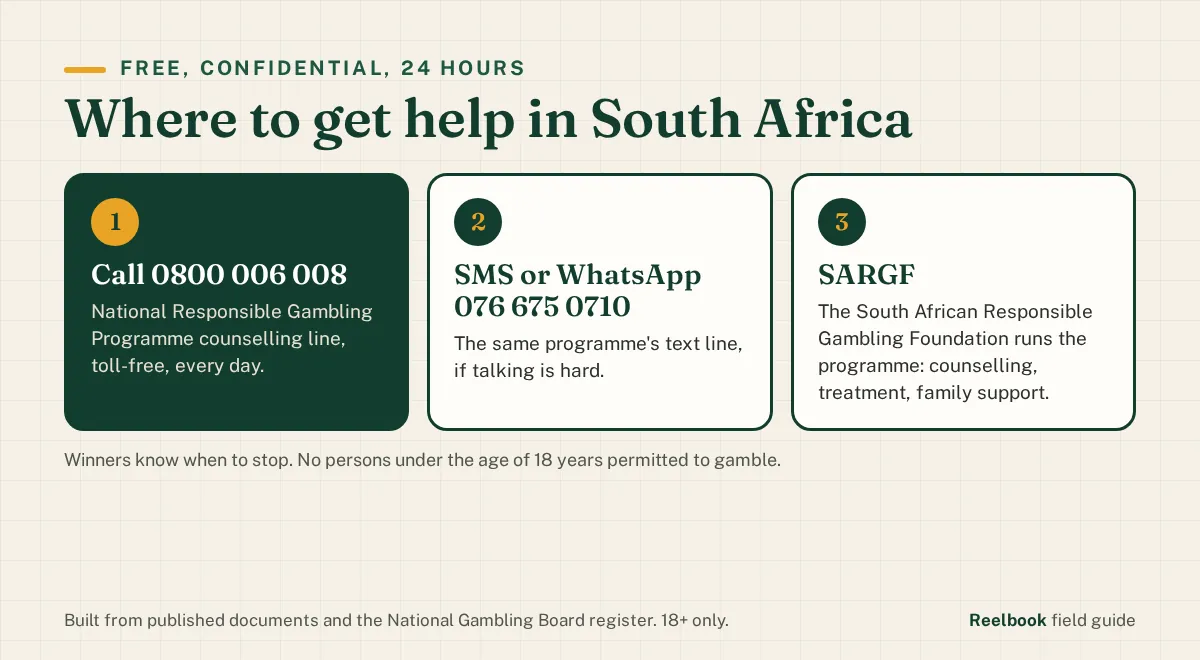
- Call, free, 24 hours0800 006 008National Responsible Gambling Programme counselling line, run by the South African Responsible Gambling Foundation. Confidential.
- SMS or WhatsApp076 675 0710The same programme's text line, if talking is hard.
- Read and self-referresponsiblegambling.org.zaSARGF website: counselling, treatment and family support.
Who can gamble: the 18+ rule
No persons under the age of 18 years are permitted to gamble in South Africa. The National Gambling Act bars minors from gambling and from pretending to be 18, and licensed bookmakers must take reasonable steps to confirm a customer's age. That is one reason FICA checks ask for an ID document before you can withdraw. The same age limit applies to National Lottery tickets.
Signs that betting is becoming a problem
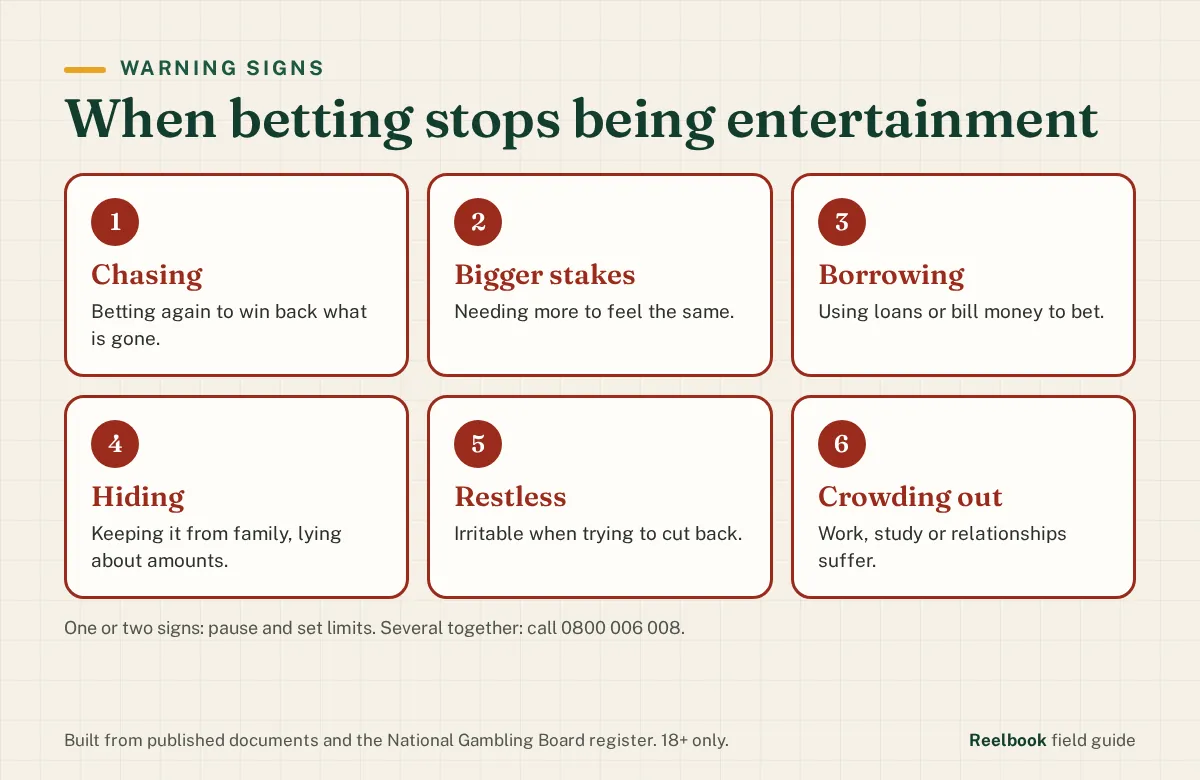
- You bet more, or more often, to get the same feeling.
- You chase losses by placing another bet to win back what is gone.
- You borrow money, use bill money or sell things to keep betting.
- You hide your betting from family or lie about how much you spend.
- You feel restless or irritable when you try to cut back.
- Betting gets in the way of work, study or relationships.
One or two of these is a reason to pause and set limits. Several together is a reason to call the helpline.
Check yourself in two minutes
Ten questions about the last twelve months, written from the warning signs counsellors describe. Answer honestly; the result appears when all ten are done. Nothing is saved, sent or remembered by this page.
If the result worries you, or if you have doubts the quiz does not cover, a counsellor on 0800 006 008 can talk it through with you. Calling does not commit you to anything.
Tools licensed bookmakers offer
Provincially licensed bookmakers describe player protection tools on their responsible gambling pages. Common ones include:
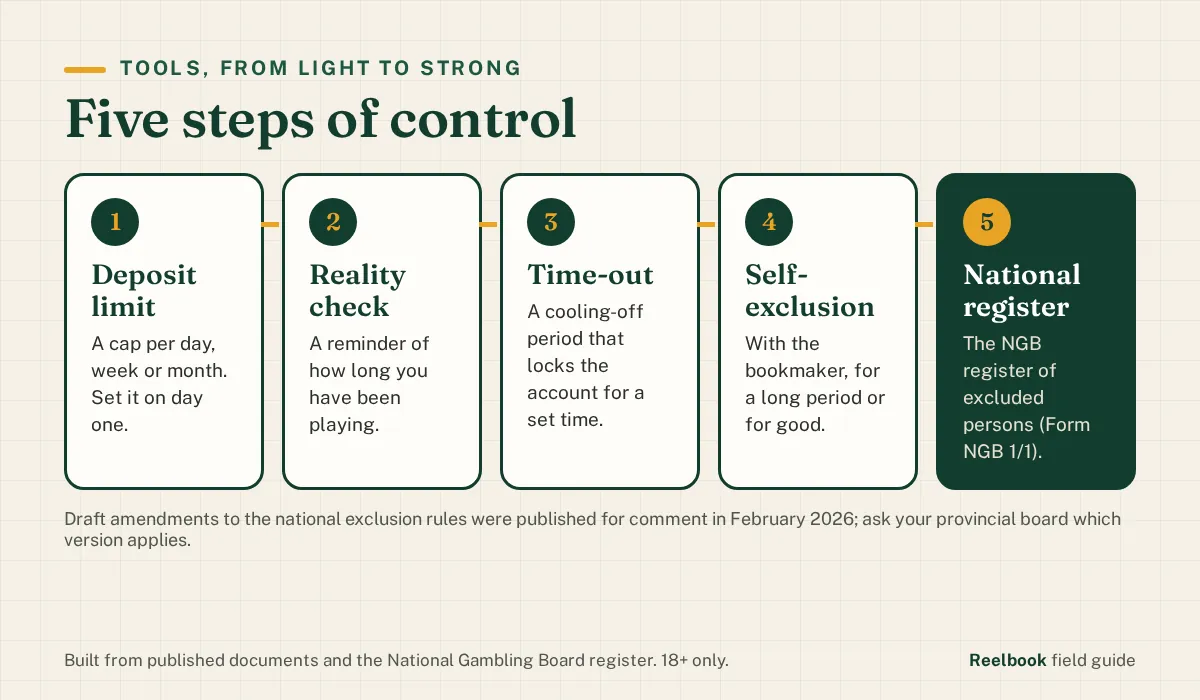
- Deposit limits for a day, week or month;
- Wagering limits that cap how much you can stake;
- Reality checks that remind you how long you have been playing;
- Time-outs or cooling-off periods that lock the account for a set time;
- Self-exclusion, which closes the account for a longer period or permanently.
Set limits when you open an account, not after a bad day. Our rating method gives player protection a fifth of every bookmaker's score, and each bookmaker review notes which tools the operator lists.
Plan your limits before you deposit
A deposit limit works best when it comes from a number you chose on a calm day. Start from money you could lose this month without missing rent, food, transport, school fees or a debt payment, and split it into weekly and per-session amounts. Then set the weekly figure as a deposit limit in every account you hold.
Lowering a limit usually takes effect at once, while raising one usually has a waiting period in the bookmaker's rules. That delay is deliberate: it gives you time to think again. Each bookmaker review lists the limit and time-out tools the operator publishes.
Self-exclusion in South Africa
You can self-exclude in two ways. The first is through the bookmaker itself, using the self-exclusion option in your account or by contacting support. The second is national: the National Gambling Act provides for a National Register of Excluded Persons kept by the National Gambling Board. You apply on Form NGB 1/1, and once accepted you are excluded from designated gambling areas nationally. Removal requires a formal application on Form NGB 1/2. A draft update to these rules was published for comment in February 2026; your provincial gambling board can tell you which version currently applies. Self-excluded players are not eligible for bonuses or promotions.
Helping someone else
If a partner, parent, child or friend is betting more than they can afford, you can call the same helpline for advice on how to raise it. Talk about what you have noticed rather than about blame, and avoid paying off gambling debts for them without a plan, because it can make the next round easier. Families can also ask the programme about counselling for themselves.
Gambling and young people
No persons under the age of 18 years are permitted to gamble, and that includes lottery tickets. If a young person in your home is betting, set up parental controls on phones and computers, keep your own betting accounts locked, and talk to them about how bookmakers make money. Licensed bookmakers must verify age, but an account opened with someone else's ID is still underage gambling.
Where to get help
The South African Responsible Gambling Foundation runs the National Responsible Gambling Programme, which provides free counselling and treatment referrals. Call 0800 006 008 at any hour, or send HELP by WhatsApp to 076 675 0710. The programme's slogan sums it up: Winners know when to stop.
Questions and answers
Is the gambling helpline free?
Yes. The National Responsible Gambling Programme line, 0800 006 008, is toll-free, confidential and available 24 hours a day, seven days a week. You can also use SMS or WhatsApp on 076 675 0710.
How do I self-exclude from all bookmakers?
Self-exclude at each bookmaker where you have an account and apply to the National Register of Excluded Persons on Form NGB 1/1. Your provincial gambling board or the helpline can guide you through it.
Can I cancel self-exclusion early?
National exclusion stays in place until a revocation application on Form NGB 1/2 is approved, and removal requires proof of completed treatment. Operator exclusions follow each bookmaker's own terms.
Does the self-check on this page store my answers?
No. It runs in your browser only; nothing is saved, sent or remembered. Clear it with the button below the questions.
How much should my deposit limit be?
Start from money you could lose this month without missing rent, food, transport, school fees or a debt payment, and divide it by weeks. The limits planner on this page does the sum.