
Ranking
Betting Exchange in South Africa: How It Works and What Is Licensed
Back, lay, liability, commission and liquidity explained with a made-up example, what research shows about exchanges at licensed SA bookmakers, and the nearest legal tools.

A betting exchange is a marketplace where punters bet against each other instead of against a bookmaker: one person backs an outcome, another lays it, and the exchange keeps a commission from the winner. In South Africa, none of the 24 provincially licensed bookmakers on our file runs one. Every licensed sportsbook we read sells fixed odds, and TAB runs tote pools, so there is no licensed betting exchange we can point you to.
This page explains the exchange model properly, with a made-up worked example, so you can see what you would and would not be missing. It then sets out what the law and the bookmakers' own documents say, and which features at licensed sites come closest: cash out, in-play betting and price comparison.
In short
- Exchange: customers set and take prices from each other; the operator matches bets and charges commission.
- South Africa: no licensed operator on file describes an exchange. Bookmakers sell fixed odds; TAB runs tote pools.
- Overseas exchanges: without a provincial licence they are not a lawful option here, and we do not name them.
- Nearest local tools: cash out, live betting and comparing prices across licensed sites.
Back, lay, liability, commission: the betting exchange vocabulary
A bookmaker sets a price and takes the other side of every bet. An exchange does neither. It is a matching engine: customers post the prices they want, other customers accept them, and the operator earns a percentage of the winnings. Six terms carry the whole idea.
| Term | What it means on an exchange | Closest idea at a bookmaker |
|---|---|---|
| Back | Bet that an outcome will happen. | An ordinary bet |
| Lay | Bet that an outcome will not happen; you pay out if it does. | None: only the bookmaker lays |
| Liability | The most a layer can lose: the backer's stake times the odds minus one. | Your stake is your maximum loss |
| Commission | The operator's percentage of a customer's net winnings on a market. | The margin built into every price |
| Liquidity | The money waiting to be matched at each price. | Stake limits and maximum liability |
| Matched or unmatched | Whether another customer has accepted your bet yet. | Accepted or declined bet |
Two of these matter more than the rest. Liability, because a lay bet can cost far more than the stake you see on screen. And liquidity, because an exchange price only exists if someone else wants the other side of it. On a quiet market a bet can sit unmatched until the event starts.
A made-up back and lay example on one match
The simplest way to see an exchange is to follow one bet from both sides. The teams, the price and the commission rate below are invented for illustration; they are not taken from any real exchange.
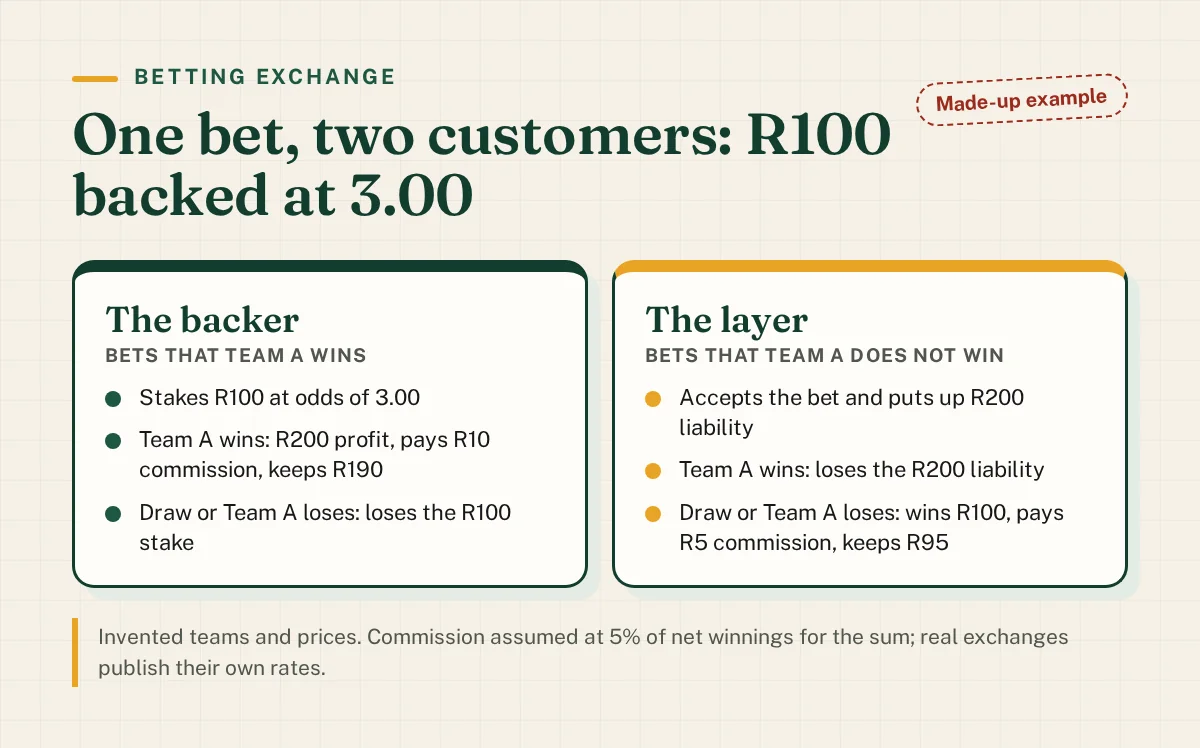
Compare that with a bookmaker. At 3.00 a bookmaker pays the same R200 profit on a winning R100 bet and charges no commission, but the 3.00 itself has the bookmaker's margin built in: its fair view of the chance might have been closer to 3.20. So the cost moves from the payout to the price. Our page on how betting odds and margins work shows how to measure that margin on any market.
Why laying an outsider is riskier than it looks
Laying feels safe because you usually win: you are betting that one result out of several will not happen. The catch is the size of the loss when it does. Liability grows with the odds, and the stake on screen is the backer's stake, not yours.
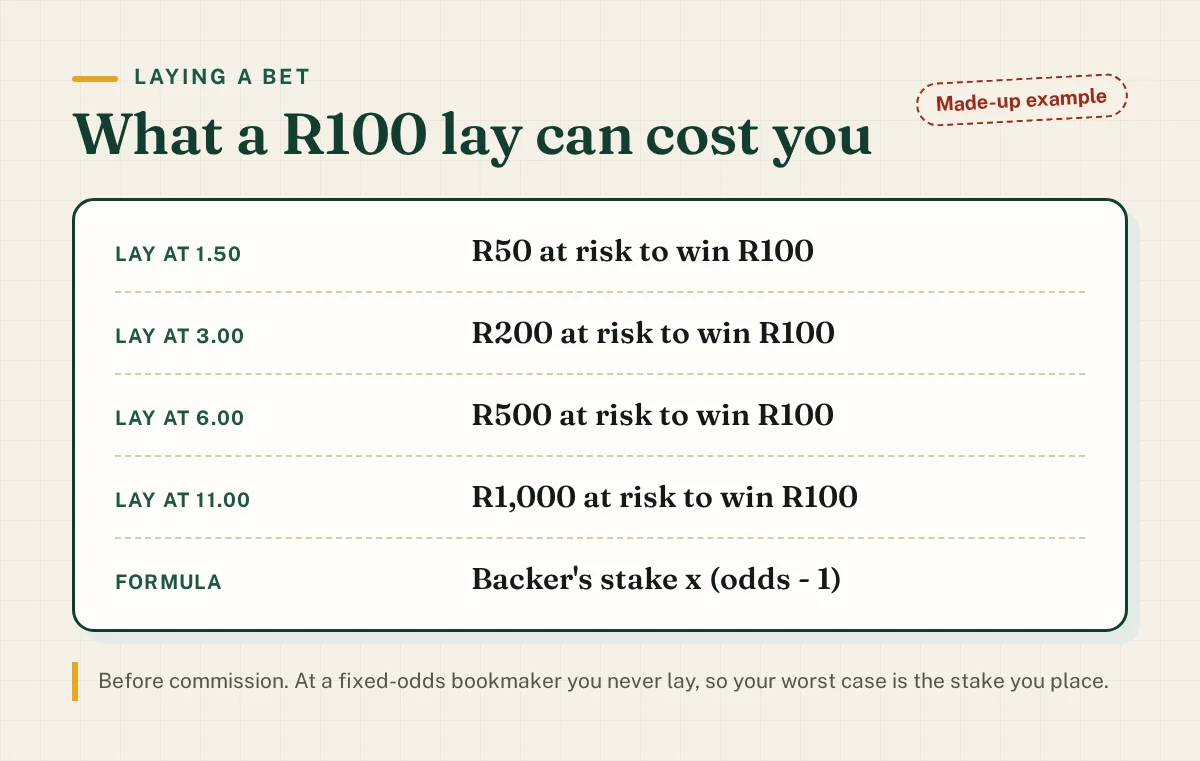
Read the table from top to bottom. Laying a short-priced favourite at 1.50 risks R50 to win R100. Laying a long shot at 11.00 risks R1,000 to win the same R100, so one upset wipes out ten wins. Exchange users who lay outsiders as a routine are effectively selling insurance, and insurance only pays while nothing goes wrong. At a fixed-odds bookmaker this risk never reaches you: Topbet's FAQ puts it plainly, saying that what you lose is the stake wagered and nothing more.
Fixed odds, tote pools and exchanges side by side
South African punters already know two betting models, even if they rarely name them. Bookmakers sell fixed odds. The tote, best known from horse racing, pools everyone's stakes and shares them out. An exchange is a third model, and the differences show up in who sets the price and who you are really betting against.
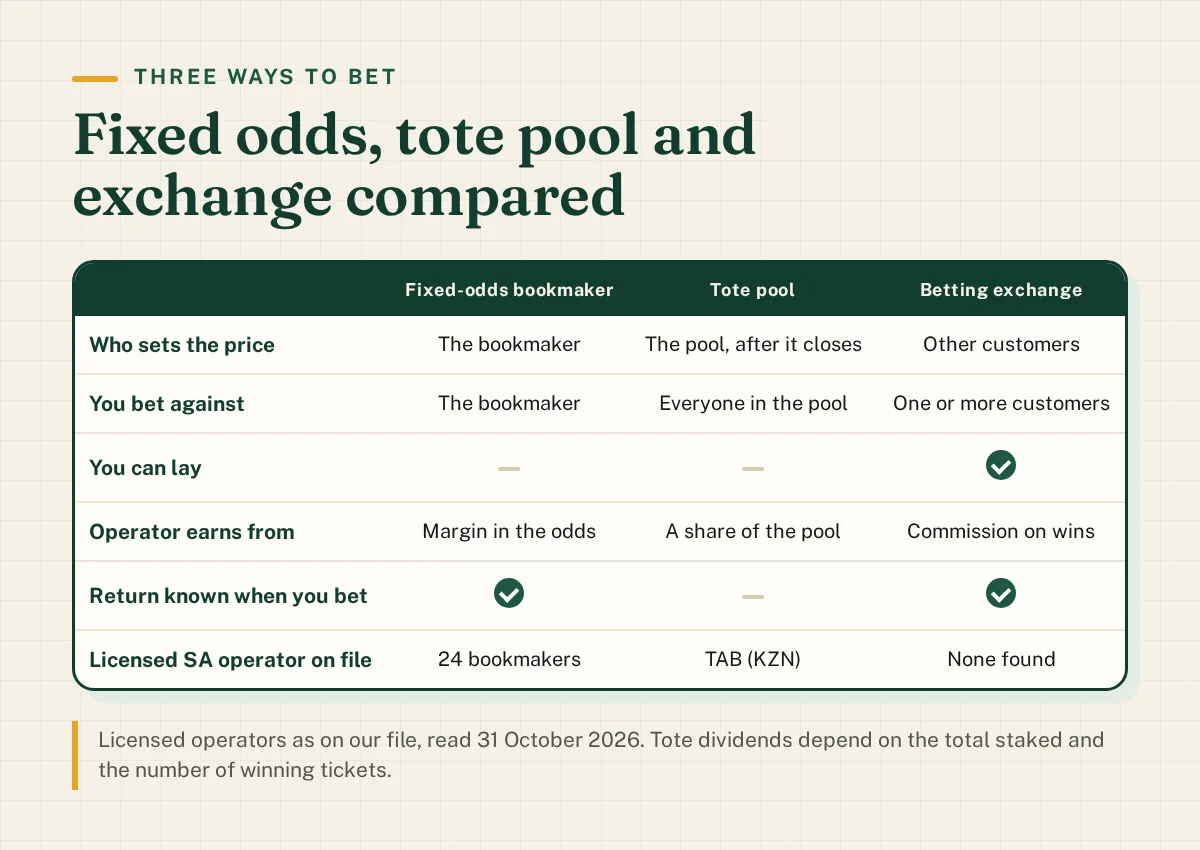
Fixed odds. Topbet's FAQ describes the model well: the bookmaker creates markets, sets odds according to what it believes the chance of each outcome is, and your payout is fixed at the odds when the bet is taken. Every licensed sportsbook on file works this way, and the price includes a margin that pays the bookmaker in the long run.
Tote pools. TAB is operated by Race Coast KZN under totalisator licence TOT0002, issued by the KwaZulu-Natal Economic Regulatory Authority on 31 March 2025. Its pools include Soccer6 and Soccer10 on football and quartet pools on racing. In a pool the dividend depends on how much was staked and on how many winning tickets share it, so you do not know your return until the pool closes. World Sports Betting also lists Racing Tote and Soccer Pools in its menu. Of the three models, the tote is the one where punters most directly play against each other, and it is fully licensed here.
Exchanges. You agree a fixed price with another customer before the event, and you can lay as well as back. That flexibility is the attraction. The cost is commission, the need for liquidity, and in South Africa the absence of a licensed operator.
Is there a licensed betting exchange in South Africa?
Online sports and horse-racing betting is legal in South Africa only with an operator licensed by a provincial gambling board, such as the Western Cape Gambling and Racing Board, the Mpumalanga Economic Regulator or the KwaZulu-Natal regulator. We hold the licence notice of 25 such bookmakers and read their terms, betting rules, help and promotions pages. None of those documents describes a betting exchange, a lay bet for customers or exchange commission. We also found no statement from a provincial board or the National Gambling Board about exchanges either way.
Playing on an unlicensed site also removes the protections a licence brings: no provincial board to complain to, no FICA-checked account in your name under South African rules, and no obligation to offer deposit limits or self-exclusion. If a licensed bookmaker ever adds an exchange product, its terms and licence notice will say so, and it will appear here. Until then, our guide to licensed betting sites shows how to check any site's licence against the register in two minutes.
Cash out, the closest thing to trading out of a bet
Exchange users trade: they back at one price and lay at another to close a position before the event ends. Licensed bookmakers do not let you lay, but many offer cash out, which closes a bet early at a value the bookmaker quotes. The published rules show how it works and where its limits are.
- Gbets says you can cash out a bet fully or partially, on selected events and markets, before the match and in-play, on single and multiple bets. Its rules name football, tennis and basketball, and a symbol on the market shows where cash out is available.
- Sportingbet says cash out is available on selected events only and may be suspended or removed at any time.
- Bet.co.za lists cash out and partial cash out among its features. Its betting rules say the early cash-out price depends on how your selections are performing, and that cash out is not available on Bet Builder bets.
- PlayBet publishes separate Early Cash Out Rules covering when an offer is made, how it is calculated and when it is withdrawn.
- Topbet, Vegas Bets, Scorebet and Lulabet also name early cash out or a cash-out option on their promotions pages, home page or bet slip.
Licensed bookmakers that name a cash-out feature
Provincially licensed bookmakers only. Each score comes from our scorecard. How we rate. Licence notices checked 1 November 2026.
| # | Bookmaker | Score | Welcome offer | Payments | Link |
|---|---|---|---|---|---|
| 1 |  Scorebet | First Deposit 100% Match (up to R5,000) plus up to 150 Free Spins on Gates of Olympus; separate R20 welcome bonus | EFT, Card Payments, Voucher, Mobile Money +7 more | Visit site | |
| 2 |  Sportingbet | Triple Welcome Bonus: up to R3,000 in bonus funds spread across first three deposits | Ozow, 1Voucher, Visa | Visit site | |
| 3 |  Gbets | 50 Free Spins and a R50 Free Bet for new customers | EFT, Credit Card, 1Voucher, OTT Voucher | Visit site | |
| 4 |  PlayBet | 100% first deposit match up to R20,000, split between Casino and Sports wallets | - | Visit site | |
| 5 |  Topbet | Welcome Bonus: R30 sports/horses & R15 Casino for new sign-ups | - | Visit site | |
| 6 |  Vegas Bets | Up to R20,000 deposit match across first three deposits on Pragmatic | - | Visit site | |
| 7 |  Bet.co.za | Up to R5000 extra bonus on first deposit; up to 50% extra on multiple bets | - | Visit site | |
| 8 |  Lulabet | - | - | Visit site |
18+ only. Betting can lead to losses and addiction, so set a budget before you start. Responsible gambling.
The table is ordered by our overall scorecard, not by the quality of each cash-out offer, which none of the bookmakers publishes as a number. Cash out does one part of an exchange trade's job. It does not do the other part, because the price is the bookmaker's.
Cash out at a bookmaker
- The bookmaker quotes a single cash-out value; you take it or leave it.
- Available only on selected events and markets, and it can be suspended.
- Your maximum loss is still the stake you placed.
- Offered by licensed sites, inside the South African rules.
Trading on an exchange
- You close a position by laying at the current market price set by other customers.
- Depends on liquidity: quiet markets may not match at all.
- A lay can carry a liability far larger than the original stake.
- No licensed operator on our file offers it to South Africans.
Exchange habits that still work at a fixed-odds bookmaker
Most of what makes a careful exchange user careful carries over to licensed bookmakers. Three habits are worth keeping, and a fourth matters most: an exchange user always checks liability before confirming. At a bookmaker the worst case is the stake, but a run of stakes adds up, so set a deposit limit first.
- Compare the price On an exchange you see the best available back price at a glance. With bookmakers you do it by hand: open the same market on two or three licensed sites and check the margin. The converter and margin check on our betting odds page do the arithmetic.
- Bet in-play with a plan Exchange trading happens mostly while a match is running. Licensed sites take in-play bets too, and their FAQs explain why markets get suspended and prices change. See live betting sites before betting mid-match.
- Read the settlement rules Exchanges publish market rules; so do bookmakers. Gbets' rules, for example, say bets struck at obviously wrong prices are void, and Bet.co.za voids a whole Bet Builder bet when one selection is void.
Find licensed sites by feature
Tick what you need. Every match comes from the bookmaker's own published pages; a missing tick means we did not find it in writing, not that the site refuses it.
The filter reads each bookmaker's published sports description, summary and strengths on our scorecard. A missing tick means we did not find the feature in writing, not that the site lacks it, so the filter and the cash-out ranking above may not match exactly.
What changes for an exchange user at a local bookmaker
If you have used an exchange abroad and now bet with a licensed South African bookmaker, a few things work differently. None of them is hidden; they sit in the terms and FAQ pages.
- Stake limits. A bookmaker carries the risk itself, so it caps it. Topbet's FAQ explains a maximum liability per market and a limit on each account; Bet.co.za's rules reserve the right to limit stakes at any time. An exchange limit is set by liquidity instead.
- Price changes in-play. Topbet's FAQ says in-play prices change every time a selection's chances change and that markets are suspended at moments such as a penalty or a third-umpire review. Expect a bet to be declined or re-priced if the odds move before you confirm.
- Bonus rules. Bookmaker welcome offers come with rollover rules that exchanges do not have. PlayBet's FAQ, for instance, says outrights, special bets and price-boost bets do not count towards its rollover.
- FICA. Licensed bookmakers verify your identity, address and bank account before you withdraw, as accountable institutions under the Financial Intelligence Centre Act.
Trading, chasing losses and the 18+ rule
Exchange trading is sometimes sold as a skill that turns betting into income. It is not: commission is charged on every winning market, prices move against you as often as for you, and a lay at long odds can cost many times the stake. The same applies to cash out at a bookmaker. If you find yourself trading or cashing out to win back what you lost, that is the moment to stop. Betting is for adults aged 18 and over; deposit limits, time-outs and self-exclusion are explained on our responsible gambling page.
Questions and answers
What is a betting exchange?
A betting exchange is a marketplace where punters bet against each other instead of against a bookmaker. One customer backs an outcome, another lays it, the exchange matches the two bets and takes a commission from the winner's net profit on that market.
Is there a betting exchange in South Africa?
Not among the licensed operators we track. In the published pages of the 24 provincially licensed bookmakers on file, every sportsbook sells fixed odds and TAB runs tote pools. None describes a peer-to-peer exchange where customers can lay bets to each other.
Can I use an overseas betting exchange from South Africa?
A site that takes bets from South Africans without a South African provincial licence is not a lawful option, whatever licence it holds elsewhere. The National Gambling Board asks the public not to gamble on any site missing from its Verified Operators list. We do not name or link such sites.
What does laying a bet mean?
Laying means betting that something will not happen. You take the role of the bookmaker: if the outcome loses, you keep the backer's stake; if it wins, you pay the backer's profit out of your own money.
How is liability worked out when you lay?
Liability is the backer's stake multiplied by the odds minus one. Laying R100 at 3.00 puts R200 at risk; laying R100 at 11.00 puts R1,000 at risk. That is why laying long odds is far riskier than it looks.
Is cash out the same as trading on an exchange?
It has a similar effect, because it settles a bet before the event ends. The difference is who sets the price: on an exchange it comes from other customers, while a bookmaker calculates the cash-out offer itself and can suspend or withdraw it, as the published cash-out rules of Gbets, Sportingbet and PlayBet explain.
How is a tote pool different from a betting exchange?
In a tote pool all stakes on a race or pool game go into one pot, the operator takes its share and the rest is divided between the winning tickets, so the dividend is only known after the event. On an exchange you agree a fixed price with another customer before the event. TAB, licensed in KwaZulu-Natal, runs tote and soccer pools such as Soccer6.
Do exchanges offer better odds than bookmakers?
Not as a rule anyone can promise. An exchange price has no bookmaker margin built in but you pay commission on winnings, and thin markets can give poor prices or no match at all. With licensed bookmakers, the practical step is to compare the same market on two or three sites before you bet.
Can I lay a horse in South Africa?
Not at the licensed bookmakers on file. Local racing is sold at fixed odds by bookmakers and through tote pools; no licensed operator we track offers ordinary customers the chance to lay a runner.