
Tool
Betting Odds Calculator: Fixed Odds Returns, Multiples and Implied Probability
Enter a stake and the odds to see the return and profit on a single or a multi, then convert prices and check how much margin a market carries.

A betting odds calculator tells you what a fixed odds bet pays before you place it. Enter the stake and the odds, and it shows the total return, the profit and the chance the price implies, for a single or for a multi of several legs. Below it you will find how fixed odds are worked out by hand, how to convert decimal, fractional and American prices, and how to measure the margin a bookmaker builds into a market.
The sums in one box
- Return: stake x decimal odds. R50 at 2.50 returns R125, so R75 profit.
- Multi: multiply the decimal odds of every leg, then x stake. All legs must win.
- Fractional to decimal: fraction + 1. 6/4 = 2.50, 20/1 = 21.00.
- Implied chance: 1 / decimal odds. 2.50 = 40%.
- Margin: add up the implied chances of every outcome; anything over 100% is the bookmaker's edge.
Choose the odds format, type your stake in rand and the odds of the first selection. Use "Add a selection" for each further leg of an accumulator; the calculator multiplies the prices and shows the combined odds, the fractional equivalent and the implied chance. Remove legs one at a time to compare a treble with a double. The result is a guide: the bookmaker's own bet slip is what counts, including any maximum payout in its terms.
What fixed odds are
Almost every sports and racing bet at a South African bookmaker is a fixed odds bet. The price is fixed when the bet is accepted, and the payout is worked out from that price whatever the odds do afterwards. Topbet's FAQ puts it plainly: "the pay-out is based on the odds at the time the bet is taken". If you back a team at 2.50 and its price drops to 1.90 before kick-off, you are still paid at 2.50.
The alternative is pool or tote betting, where all stakes go into a pool and the dividend is only known after the event. Horse racing tote bets and soccer pools work that way, so a fixed odds calculator cannot price them. Everything on this page applies to fixed odds only.
- Fixed when accepted The price on your slip at the moment the bookmaker accepts the bet decides the payout. Live prices can change while you confirm, and the slip asks you to accept the new price.
- Stake included Decimal odds include the stake. A return of R250 on R100 means R150 profit, not R250.
- Rules still apply Void legs, dead heats, maximum payouts and palpable error rules come from the bookmaker's terms, not from the calculator.
How a fixed odds calculator works out returns
Singles
A single is one selection. Return = stake x decimal odds; profit = return minus stake. R20 at 3.40 returns R68, so R48 profit. If the bet loses, you lose the R20 and nothing more.
Multiples and accumulators
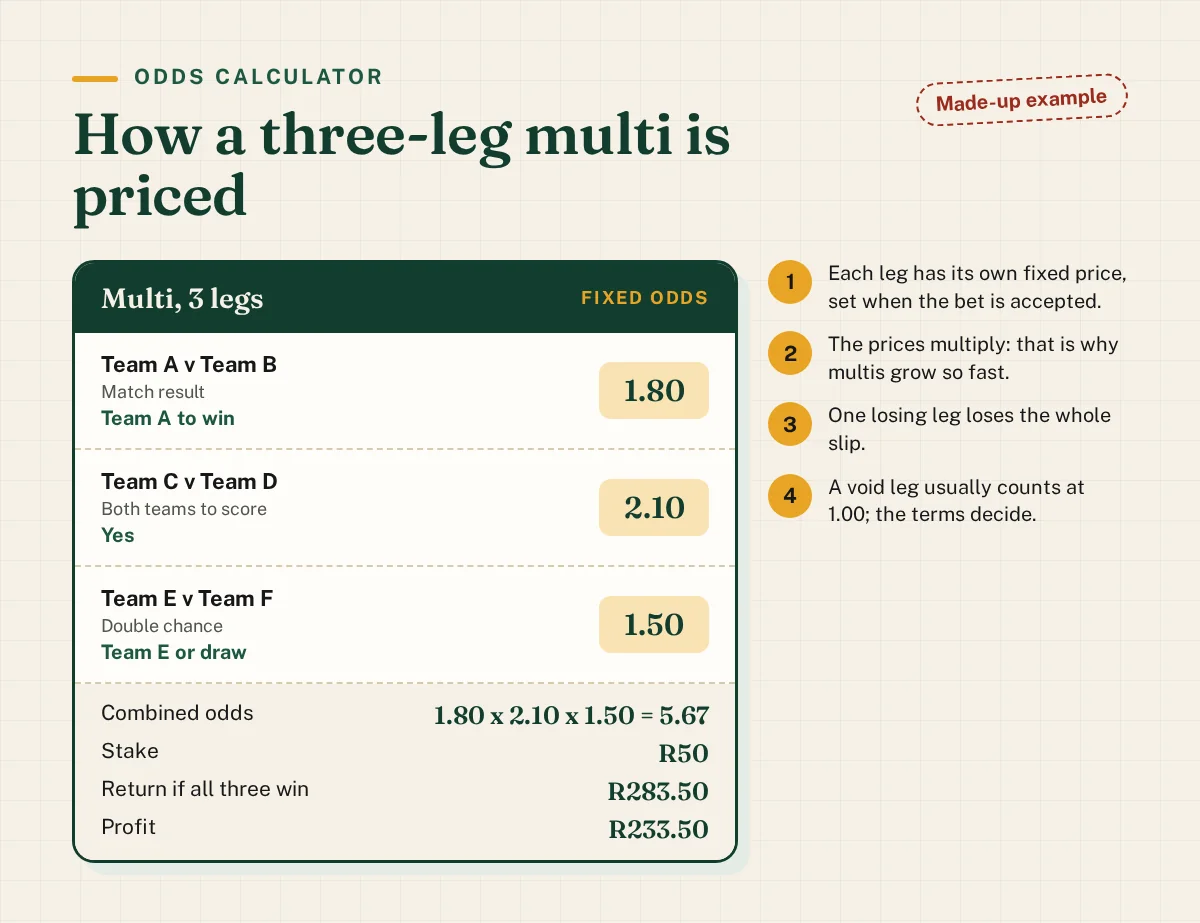
A multi, also called an accumulator, links two or more selections from different events. The decimal odds are multiplied, which is why the potential return grows so fast: three legs at 1.80, 2.10 and 1.50 give combined odds of 5.67, and a R50 stake returns R283.50. Every leg must win. If one leg is void, for example a postponed match, most bookmakers count it at odds of 1.00 and settle the rest; your bookmaker's rules decide.
System bets
A system bet splits one slip into several multiples, each a separate bet with its own stake. A Trixie on three selections is three doubles and a treble, four bets in all; a Yankee on four selections is eleven bets. The calculator above handles one line at a time, so for full systems use the bet slip and system bet calculator, which counts the lines and the total stake for you.
Decimal, fractional and American odds side by side
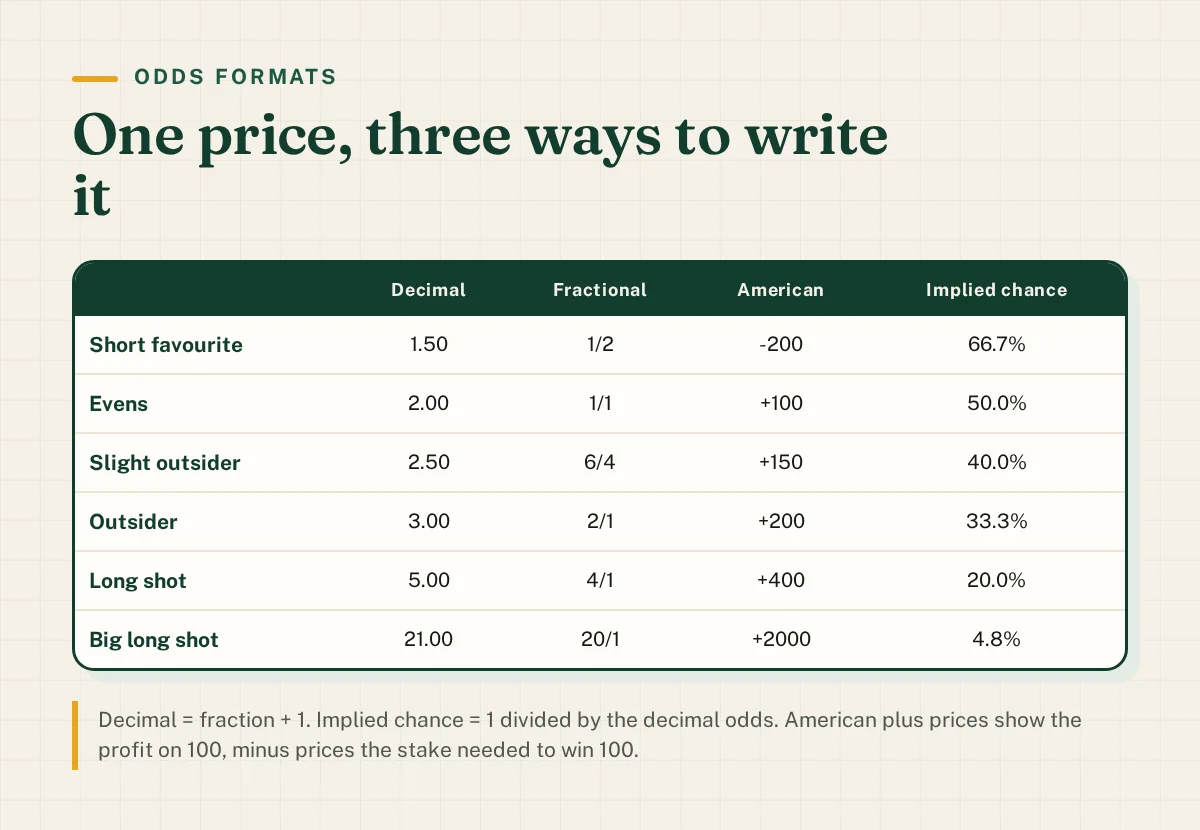
South African bookmakers show decimal odds by default. Fractional odds still turn up in horse racing, and American (moneyline) odds appear on US sports. They are three ways of writing the same price.
| Decimal | Fractional | American | Implied chance | R100 returns |
|---|---|---|---|---|
| 1.50 | 1/2 | -200 | 66.7% | R150 |
| 2.00 | 1/1 (evens) | +100 | 50.0% | R200 |
| 2.50 | 6/4 | +150 | 40.0% | R250 |
| 3.00 | 2/1 | +200 | 33.3% | R300 |
| 5.00 | 4/1 | +400 | 20.0% | R500 |
| 21.00 | 20/1 | +2000 | 4.8% | R2,100 |
The conversions are short. Fractional to decimal: divide the top by the bottom and add 1, so 6/4 is 1.5 + 1 = 2.50. Decimal to fractional: subtract 1 and write it as a fraction, so 3.00 becomes 2/1. American plus prices show the profit on R100, so +150 means R150 profit and decimal 2.50. American minus prices show what you must stake to win R100, so -200 means R200 to win R100, decimal 1.50. That is all a moneyline calculator does.
Implied probability: what a price says about the chance
Divide 1 by the decimal odds and you get the implied probability: 2.00 is 50%, 4.00 is 25%, 1.25 is 80%. It is the chance at which the bet would break even over many tries. If you think a result happens more often than the price implies, the price is better than it should be; if less often, it is worse. That comparison, not the size of the return, is the useful part of any calculator.
Implied probability is not a forecast. It is the bookmaker's estimate with its margin added, shaped by how the money has come in. A 25% price can win twice in a row, and an 80% price can lose; over hundreds of bets the margin is what shows.
The bookmaker's margin, worked through
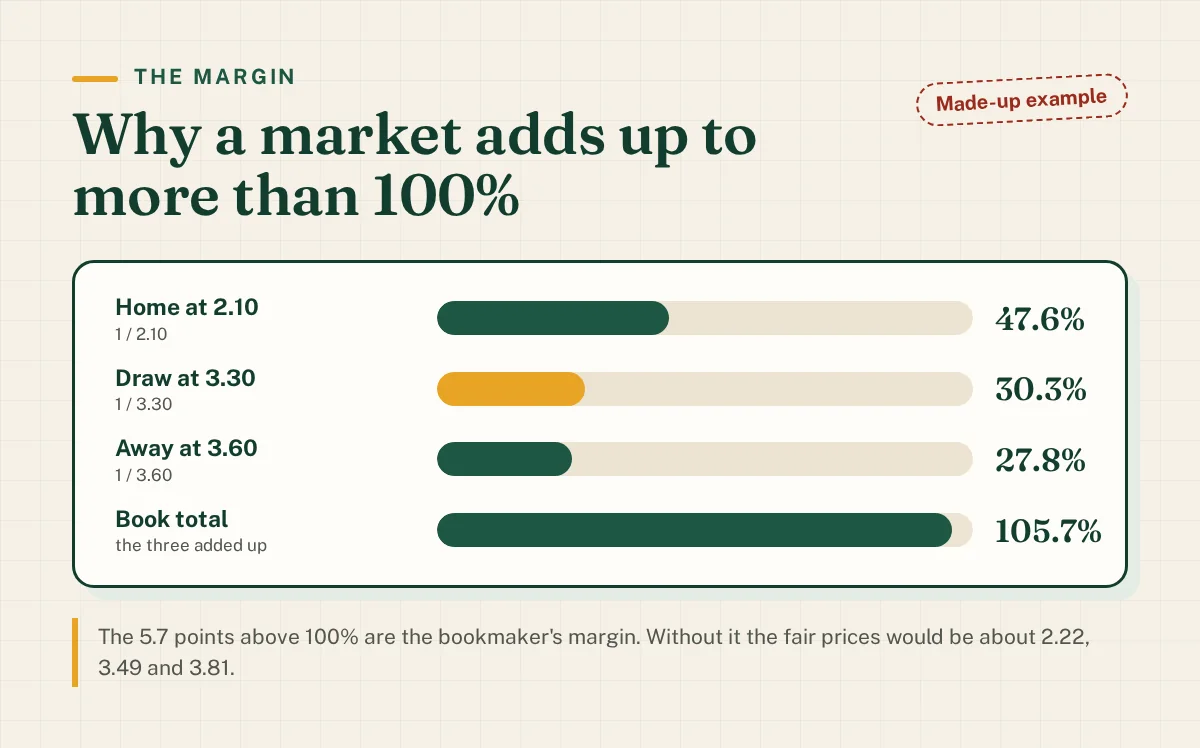
Add up the implied chances of every outcome in one market. On a soccer match priced 2.10 home, 3.30 draw and 3.60 away, they come to 47.6% + 30.3% + 27.8% = 105.7%. The 5.7 points above 100% are the overround, the margin that pays the bookmaker whatever the result. Strip it out and the fair prices would be about 2.22, 3.49 and 3.81.
In a multi the margin multiplies with the odds. Four legs that each carry about 5% give a combined book of roughly 121%, so on average you get back about 82 cents of every rand staked on such a slip over time. That is why long accumulators look generous and rarely land. Comparing prices for the same market at two or three licensed bookmakers is the simplest way to pay less margin; our betting odds comparison covers how.
The converter below does both jobs: type a price in any format to see the others, and enter the odds of every outcome in one market to see its book total, its margin and the fair odds without it.
Odds converter and margin check
Convert a price
Type into any box; the others follow.
Check a market's margin
Enter the decimal odds for every outcome of one market (home, draw, away, or two sides).
- Book total
- -
- Margin
- -
- Fair odds without margin
- -
Implied chance = 1 / decimal odds. A book total above 100% is the bookmaker's built-in margin. Prices only describe the bookmaker's view; they do not predict a result.
Racing: each-way and place terms
An each-way bet is two equal bets, one to win and one to place, so R20 each way costs R40. If the horse wins, both parts pay. If it only places, the place part pays at a fraction of the win odds, such as one quarter or one fifth, depending on the number of runners and the race type; the bookmaker's racing rules give the place terms.
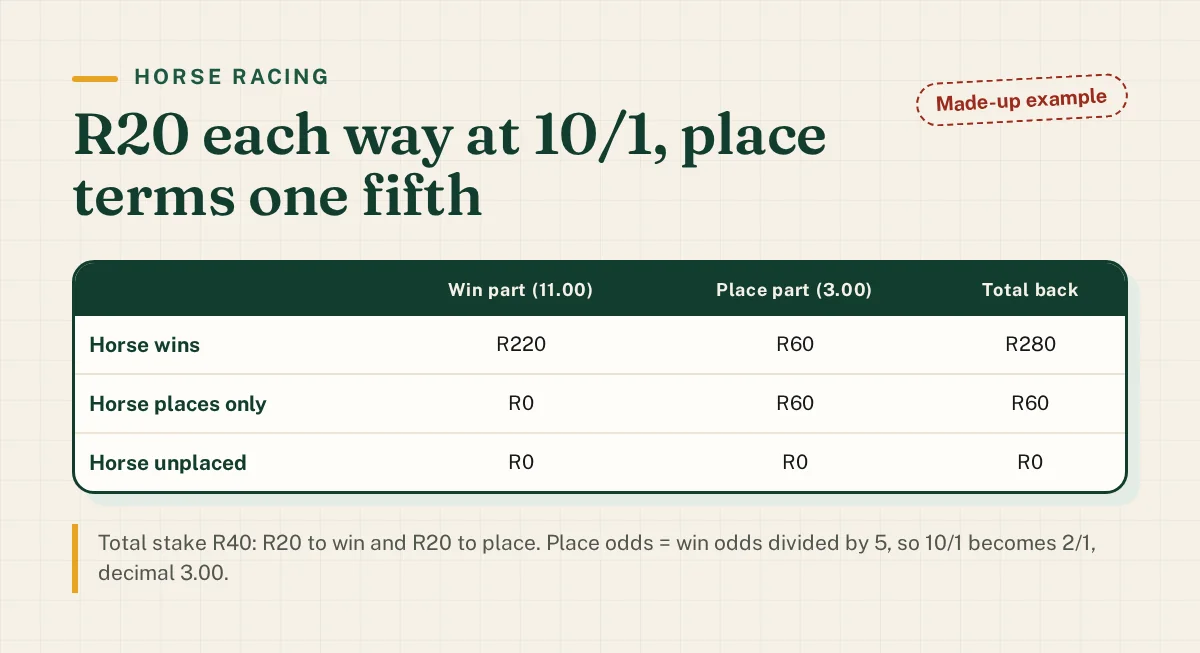
To use the calculator above for an each-way bet, run the win part at the full odds, then the place part at the reduced odds, and add the two returns.
Bonus bets, cash out and matched betting sums
Bonus stakes change the maths. With most bonus bets, often called a "free bet", the stake is not returned, so R50 at 4.00 pays R150 profit rather than R200 return. Cash out offers are set by the bookmaker and include its margin. Calculators sold for matched betting and arbitrage do the same division and multiplication as this page across several bookmakers at once; they cannot stop prices moving between bets, accounts being limited or bets being voided under the terms. The betting strategy guide covers those risks honestly.
Betting is for adults 18 and over, and a calculator shows what a bet pays, not whether it will win. If the numbers start to matter more than the match, see our responsible gambling page for limits and confidential help.
Questions and answers
How do I calculate the return on a fixed odds bet?
Multiply the stake by the decimal odds. R100 at 2.50 returns R250: your R100 stake back plus R150 profit. With fractional odds, add 1 to the fraction first: 3/2 is 1.5 plus 1, so 2.50.
How much does 20 to 1 pay?
20/1 pays R20 profit for every R1 staked, so the decimal price is 21.00. A R10 bet returns R210, of which R200 is profit.
How are accumulator odds calculated?
Multiply the decimal odds of every leg. Legs at 1.80, 2.10 and 1.50 give 5.67, so R50 returns R283.50 if all three win. One losing leg loses the whole bet.
What does implied probability mean?
It is the chance a price stands for: 1 divided by the decimal odds. Odds of 4.00 imply 25%. It describes the bookmaker's view plus its margin, not the real chance of the result.
How do I convert American (moneyline) odds to decimal?
For a plus price, divide by 100 and add 1: +150 is 2.50. For a minus price, divide 100 by the number and add 1: -200 is 1.50.
How does a "free bet" change the return?
With most bonus bets the stake is not paid back, so you only receive the profit. R50 at 4.00 pays R150, not R200. Check the bookmaker's terms, as rules differ.
How does an each-way bet pay?
It is two equal bets, one to win and one to place. If the horse only places, the place part pays at a fraction of the win odds, such as one fifth, set by the race's place terms.