
Ranking
Betting Odds in South Africa: How to Read, Convert and Compare Them
Decimal, fractional and American odds converted, the margin hidden in every market, a margin checker and a plain method for comparing prices across licensed SA bookmakers.

Betting odds tell you two things at once: how much a winning bet pays and how likely the bookmaker thinks the outcome is. South African bookmakers quote decimal odds, so R100 at 2.50 returns R250 if it wins: your R100 stake plus R150 profit. Every price also hides a margin for the bookmaker, and because no licensed bookmaker we read publishes its margins, the only reliable way to get a better price is to compare the same market at more than one licensed site.
This page explains how to read decimal, fractional and American odds, how to turn any price into a percentage, how to measure the margin in a market and how to compare prices without guesswork. A converter and margin check sit halfway down.
Betting odds in short
- Return: stake x decimal odds. R50 at 3.00 returns R150.
- Implied chance: 1 / decimal odds. 2.00 means 50%, 4.00 means 25%.
- Margin: add the implied chances of all outcomes; anything over 100% is the bookmaker's cut.
- Best price: changes match by match, so compare two or three licensed sites before each bet.
Licensed bookmakers to compare prices on
Provincially licensed bookmakers only. Each score comes from our scorecard. How we rate. Licence notices checked 1 November 2026.
| # | Bookmaker | Score | Welcome offer | Payments | Link |
|---|---|---|---|---|---|
| 1 |  Betshezi | Up to R10,000 in match bonuses over first four deposits, plus R50 bonus sports bet after FICA verification | Capitec Pay, Ozow, PayShap, bank EFT +6 more | Visit site | |
| 2 |  Scorebet | First Deposit 100% Match (up to R5,000) plus up to 150 Free Spins on Gates of Olympus; separate R20 welcome bonus | EFT, Card Payments, Voucher, Mobile Money +7 more | Visit site | |
| 3 |  SunBet | - | EFT, Ozow, Debit card, Credit card | Visit site | |
| 4 |  Sportingbet | Triple Welcome Bonus: up to R3,000 in bonus funds spread across first three deposits | Ozow, 1Voucher, Visa | Visit site | |
| 5 |  World Sports Betting | - | Credit card, EFT, Ozow, SID +5 more | Visit site | |
| 6 |  Gbets | 50 Free Spins and a R50 Free Bet for new customers | EFT, Credit Card, 1Voucher, OTT Voucher | Visit site | |
| 7 |  PlayBet | 100% first deposit match up to R20,000, split between Casino and Sports wallets | - | Visit site | |
| 8 |  Betfred | Up to R21,000 plus 750 free spins for new customers | - | Visit site | |
| 9 |  Topbet | Welcome Bonus: R30 sports/horses & R15 Casino for new sign-ups | - | Visit site | |
| 10 |  YesPlay | 100% deposit bonus up to R3,000, minimum deposit R20, valid 7 days | - | Visit site |
18+ only. Betting can lead to losses and addiction, so set a budget before you start. Responsible gambling.
The table is ordered by our overall scorecard (licence, protection, bonus terms, payments, offer and transparency). It does not rank whose prices are highest, which no published document shows and which changes with every match.
Decimal odds: what a bet returns and what it implies
Decimal odds include your stake, which makes them the easiest format to read. Multiply the stake by the odds and you have the total return. Divide 1 by the odds and you have the implied chance, the probability that the price represents.
| Decimal odds | Implied chance | Return on R50 | Profit on R50 |
|---|---|---|---|
| 1.25 | 80% | R62.50 | R12.50 |
| 1.50 | 67% | R75 | R25 |
| 2.00 | 50% | R100 | R50 |
| 3.00 | 33% | R150 | R100 |
| 5.00 | 20% | R250 | R200 |
| 11.00 | 9% | R550 | R500 |
Topbet's FAQ describes how fixed odds work: the bookmaker sets odds according to what it believes the chance of each outcome is, your winnings are the stake multiplied by the odds, and your loss is limited to the stake. The price is fixed when the bet is accepted, even if it moves afterwards. For multiples, the odds of each leg are multiplied: a three-leg multi at 1.50, 1.80 and 2.00 pays 5.40 times the stake, but only if all three win. Our odds calculator works out singles, multis and system bets.
Fractional, American and decimal odds side by side
Most South African sites show decimal prices, but fractional odds still turn up in horse racing and on international pages, and American odds appear in some US sports coverage. They all describe the same thing in a different way.
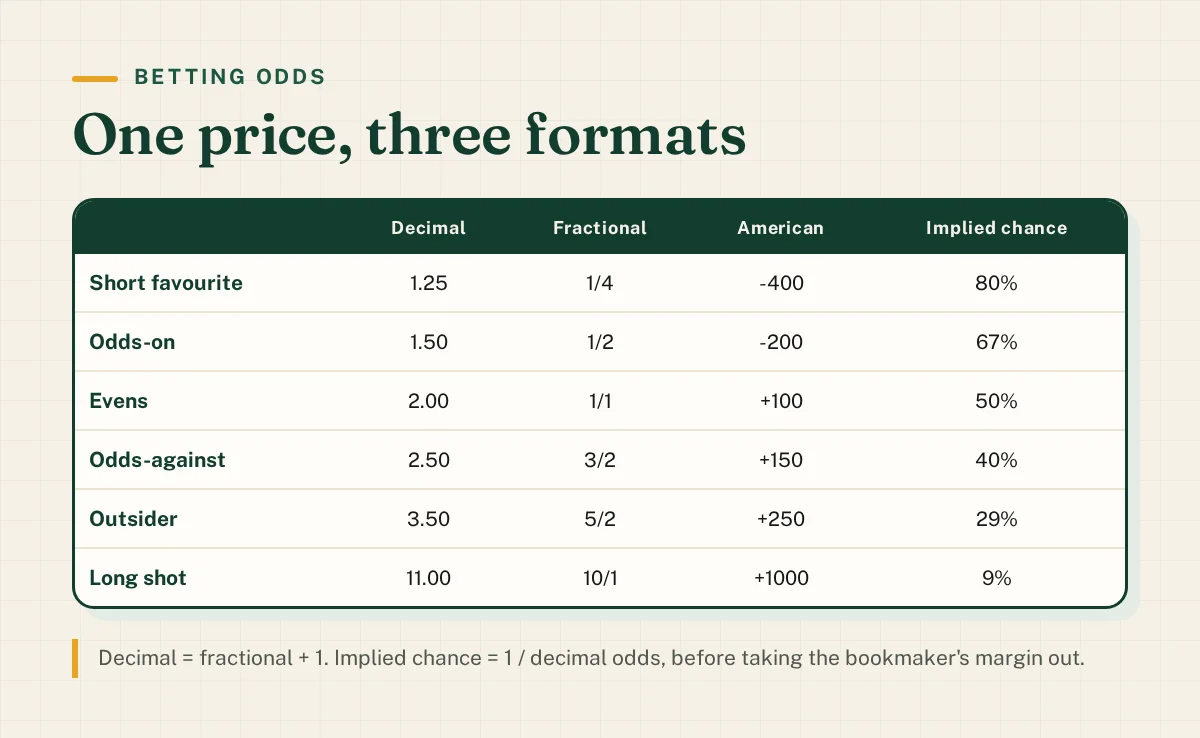
- Fractional to decimal: divide, then add 1. 5/2 becomes 3.50, 1/4 becomes 1.25.
- American to decimal: for a plus number, divide by 100 and add 1 (+150 is 2.50). For a minus number, divide 100 by the number and add 1 (-200 is 1.50).
- Odds-on and odds-against: a price below 2.00 (fractions such as 1/2, American minus numbers) is odds-on: the outcome is rated more likely than not, and you win less than you stake.
Implied probability and the bookmaker's margin
If a bookmaker priced a market fairly, the implied chances of all its outcomes would add up to exactly 100%. They never do. The amount over 100% is the margin, sometimes called the overround or the vig, and it is how the bookmaker earns over many bets regardless of results.
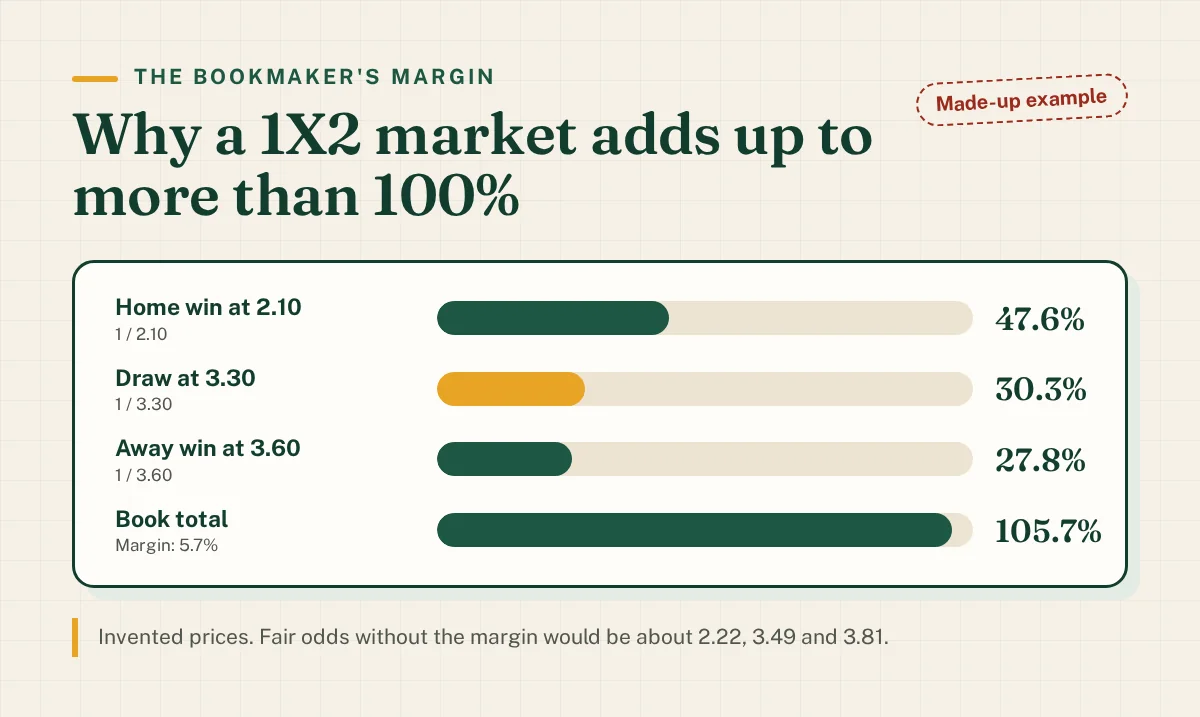
Take the made-up market in the chart: home 2.10, draw 3.30, away 3.60. The implied chances are 47.6%, 30.3% and 27.8%, a total of 105.7%. Remove the margin by scaling each chance down so they add up to 100%, and the fair prices come out at about 2.22, 3.49 and 3.81. Every bet in that market pays a little less than fair, which over hundreds of bets is what you pay for betting.
The tool below does this for you. Type a price into any box of the converter and the other formats follow. Enter the odds for every outcome of one market in the margin check to see the book total, the margin and the fair odds without it.
Odds converter and margin check
Convert a price
Type into any box; the others follow.
Check a market's margin
Enter the decimal odds for every outcome of one market (home, draw, away, or two sides).
- Book total
- -
- Margin
- -
- Fair odds without margin
- -
Implied chance = 1 / decimal odds. A book total above 100% is the bookmaker's built-in margin. Prices only describe the bookmaker's view; they do not predict a result.
Why some markets carry bigger margins than others
No licensed bookmaker on our file publishes its margins, so you have to measure them. A few patterns follow from the arithmetic and are worth knowing before you compare:
- Multiples compound the margin Each leg of a multi carries its own margin, and multiplying the odds multiplies the margins too. Three legs priced about 5% short of fair each leave the combined price roughly 14% short of fair.
- Two-way markets are easy to check Over/under, both teams to score and tennis match winners have two outcomes, so the margin check needs just two prices. A two-way market at 1.90 and 1.90 carries a margin of about 5.3%.
- Outrights and specials vary most League winners, World Cup winners, player props and bet builder combinations have many outcomes or are priced by the bookmaker as a package, so they are harder to compare and often less generous.
This is why a boosted multi or an acca bonus is not automatically a good deal: it may only return part of the extra margin the multi added in the first place. The betting strategy guide covers staking and multiples in more detail.
How to compare odds across licensed bookmakers
Prices for the same match differ from site to site because each bookmaker sets its own odds and moves them with the money it takes. The difference on one bet looks small. Over a season of bets it is the difference between a small loss and a bigger one.
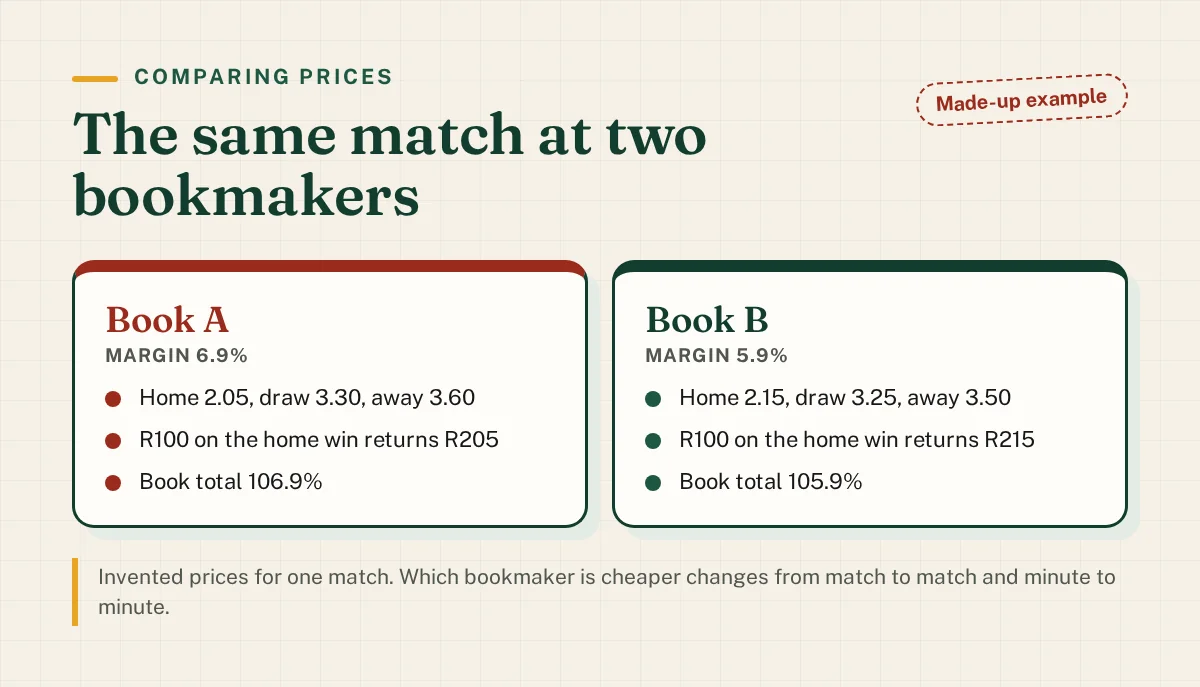
- Choose the market first. For example, the match result of a PSL fixture, or over 2.5 goals.
- Open the same market at two or three licensed sites. Use the bookmakers you already hold verified accounts with.
- Compare the price on your selection. A higher decimal number pays more for the same stake.
- Check the whole market's margin. A site with a lower margin across the board is likely to be competitive on other selections too.
- Read the conditions. Minimum odds for bonuses, maximum stakes and whether a boost is paid in cash or bonus funds.
- Keep to the stake you planned. A better price is not a reason for a bigger bet.
Comparing in-play prices is harder because they move every few seconds and markets suspend at key moments; our page on live betting sites explains what happens to a price mid-match.
Odds boosts, enhanced multiples and price promotions
Bookmakers compete on headline prices through boosts. These are published on their promotions pages and are worth knowing about, as long as you read the rules attached.
- Gbets says it boosts the Match Winner odds on selected soccer matches every week, adds up to 30% extra on multi-leg bets and lets you request boosted odds through its Super Bet feature.
- Sportingbet advertises a Multi Boost of up to 500% with a payout of up to R10 million, plus Enhanced Accas and Price Boosts on major rugby matches.
- Bet.co.za lists Enhanced Multiples and a multi bonus of up to 50%; PlayBet runs Price Boosts and a Multi Leg Bonus; World Sports Betting names odds boosters.
A boost raises one price for a limited time, often with a maximum stake. A multi bonus pays a percentage on top of a winning multiple, which usually requires a minimum number of legs at minimum odds. PlayBet's FAQ also notes that price-boost bets do not count towards its welcome rollover, so a boost and a bonus do not always work together.
Minimum odds in bonus terms, and what they imply
Welcome offers often say a bet only counts if it is placed at or above a minimum price. Turned into implied chances, those minimums show how much risk each offer asks you to take.
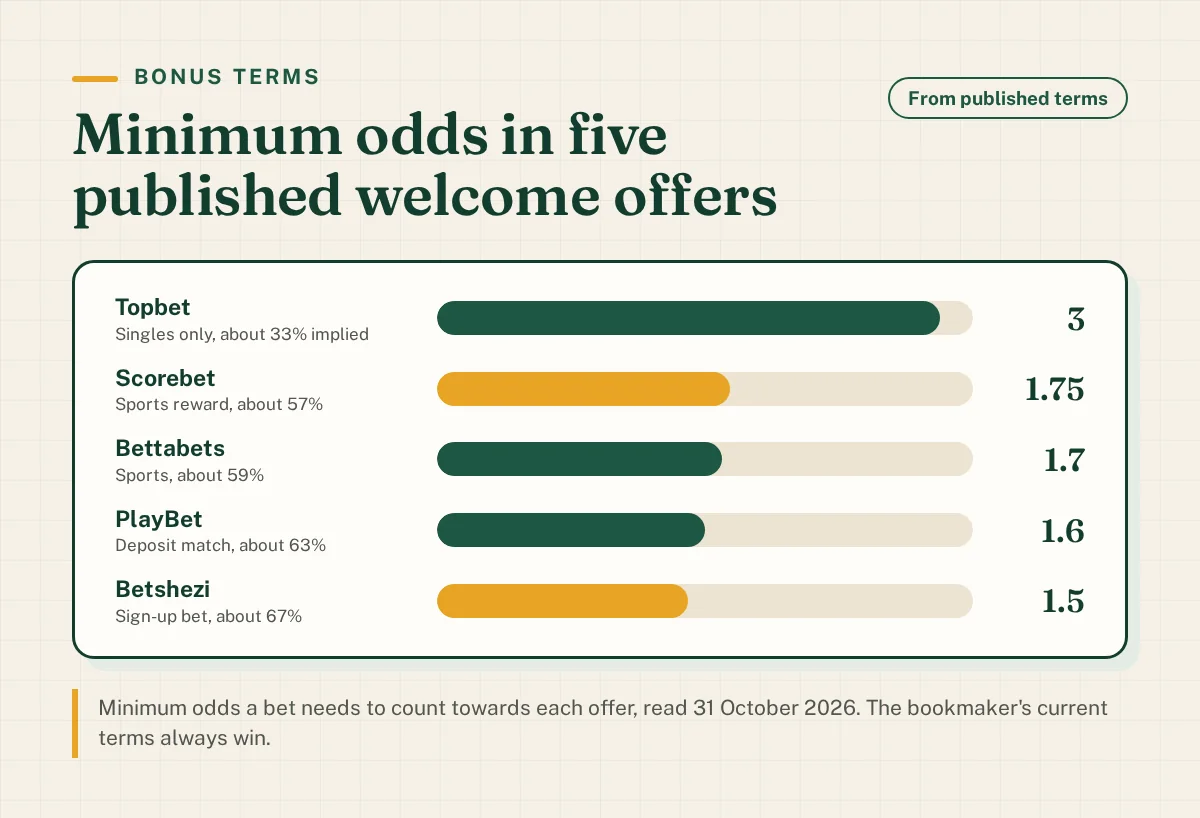
A minimum of 1.5 can be met with a strong favourite that the price rates at about 67%. A minimum of 3.0 for singles, as in Topbet's first-deposit terms, means backing outcomes rated around 33% or less, so most qualifying bets lose. Neither is wrong, but they suit different bettors. The welcome bonus guide sets each minimum next to the rollover and deadline.
Odds on soccer, horse racing and outrights
Soccer. The main markets are the match result (1X2), double chance, over/under goals and both teams to score. Big matches in the Betway Premiership or the English Premier League are the easiest to compare because every licensed bookmaker prices them.
Horse racing. Racing is sold two ways. Bookmakers offer fixed odds, and World Sports Betting advertises early prices on local and international racing. The tote, run in KwaZulu-Natal by TAB, pays a dividend from the pool instead, so the return is only known after the race. Read each bookmaker's racing rules for non-runners and dead heats; Topbet's FAQ, for example, says a multiple with a scratched selection is recalculated without it.
Outrights. League winner, World Cup and Formula 1 championship prices cover a whole competition. Your stake is tied up until the market settles, sometimes for months, and prices on long shots tend to carry the widest margins.
Why sure odds do not exist
Searches for "sure odds" or "2 odds sure" promise something no price can give. A price is the bookmaker's view of a chance, with its margin added, not a prediction. Odds of 1.20 imply about 83%, so even before the margin that bet loses roughly one time in six.
Odds, margin and your betting budget
The margin means that, over enough bets, you can expect to lose roughly the margin multiplied by everything you stake: about R5 for every R100 staked in a 5% market. Better prices shrink that cost but do not remove it. Decide what you can afford to lose each month, set it as a deposit limit at every licensed site you use and stop when it is gone. Betting is for adults aged 18 and over; more help is on our responsible gambling page.
Questions and answers
How do I calculate winnings from decimal odds?
Multiply the stake by the odds to get the total return, then take away the stake for the profit. R100 at 1.80 returns R180: R80 profit plus your R100 back.
How do I convert fractional odds to decimal?
Divide the first number by the second and add 1. 5/2 is 2.5 plus 1, so 3.50 in decimal; 1/2 is 0.5 plus 1, so 1.50. Evens (1/1) is 2.00.
What do American odds such as +150 or -200 mean?
A plus number is the profit on a R100 stake, so +150 means R150 profit, or 2.50 in decimal. A minus number is what you must stake to win R100, so -200 means staking R200 to win R100, or 1.50 in decimal.
What is implied probability?
It is the chance a price represents, worked out as 1 divided by the decimal odds. Odds of 2.00 imply 50%, odds of 4.00 imply 25%. Because of the margin, the bookmaker's real estimate is a little lower than the implied figure.
How do I work out a bookmaker's margin?
Add up the implied chances of every outcome in one market. A home, draw and away market at 2.10, 3.30 and 3.60 adds up to about 105.7%, so the margin is about 5.7%. The margin check on this page does the sum for you.
Which betting site has the best odds in South Africa?
No licensed bookmaker we read publishes its margins, and prices change match by match, so no site can honestly be called the best for odds overall. The reliable method is to compare the same market at two or three licensed bookmakers just before you bet.
Why do odds change before and during a match?
Bookmakers move prices when the chance of an outcome changes, for example after team news, and when money comes in on one side. Topbet's FAQ explains that in-play prices change every time a selection's chance of winning changes.
Are there sure odds or safe bets?
No. Odds of 1.20 imply about an 83% chance, so the bet still loses about one time in six, and five such legs in one multi lose more often than they win. Anyone selling sure odds or fixed matches should be avoided.
Do boosted odds count towards a welcome bonus rollover?
Not always. PlayBet's FAQ says price boost bets, outrights and special bets do not count towards its deposit-match rollover. Check the bonus terms before using a boosted price to clear a bonus.