
How we rate betting sites
Six weighted criteria, a score out of 5 and a strict rule: no licence notice, no ranking.
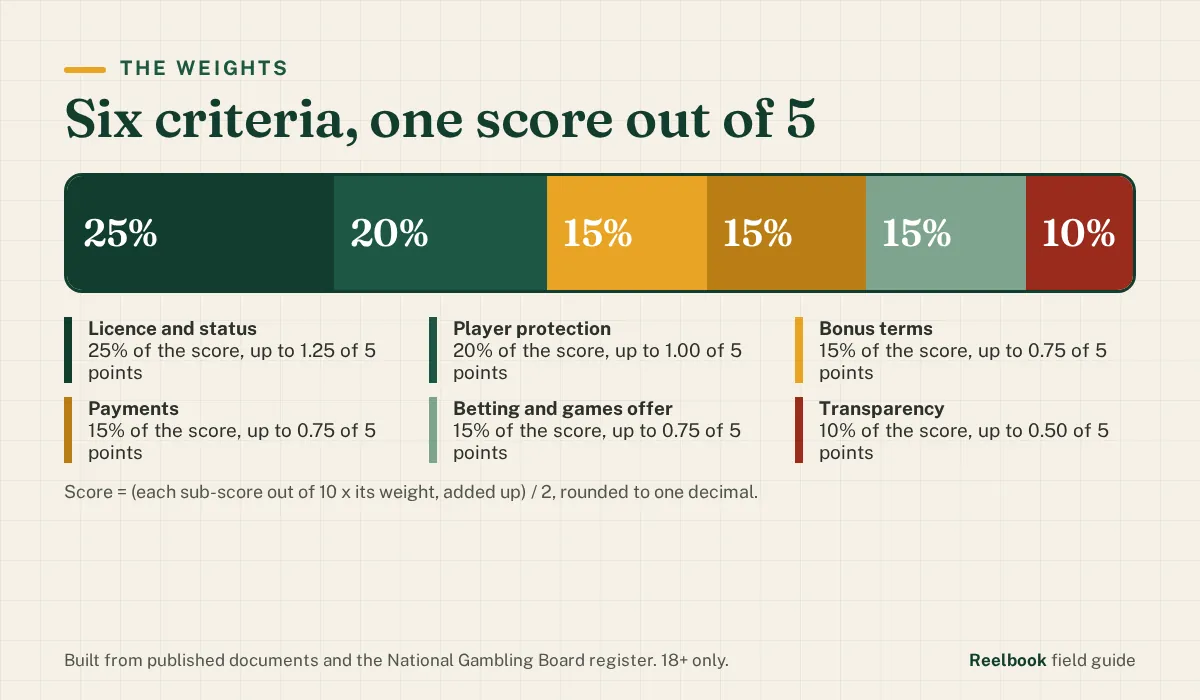
Every bookmaker on SafeBets gets a score out of 5 built from six criteria. Each criterion is marked from 0 to 10 using the operator's own published documents, the marks are weighted, and the weighted total is halved to give one decimal out of 5. The same method applies to every operator, whether or not it has an affiliate agreement with the site, and the calculator on this page uses the very same weights as the scorecards.
The six criteria and their weights
The table is generated from the scoring code itself, with the current average and range across the licensed bookmakers we list, so it always matches the scorecards on the review pages.
| Criterion | Weight | Max points of 5 | What earns marks | Average now | Range |
|---|---|---|---|---|---|
| Licence and status | 25% | 1.25 | Provincial licence named in the footer and matched to a register | 9.5 | 9 to 10 |
| Player protection | 20% | 1.00 | 18+ notice, NRGP line, limits, time-outs, self-exclusion | 6.8 | 5 to 9 |
| Bonus terms | 15% | 0.75 | Rollover, minimum odds, expiry and eligible bets written down | 5.3 | 5 to 7 |
| Payments | 15% | 0.75 | Local methods named, payout times and limits published | 5.8 | 4 to 9 |
| Betting and games offer | 15% | 0.75 | Sports, racing, live betting, apps and the games lobby | 7.2 | 5 to 9 |
| Transparency | 10% | 0.50 | Company and registration number, full terms, reachable support | 7.4 | 5 to 9 |
Licence and status (25%)
The heaviest weight, because nothing else matters if the bookmaker is not licensed. Full marks need a provincial board named in the footer with a licence number that matches the National Gambling Board's verified operators list or the board's own list. Marks come off when the number in the footer and the register differ, when the company in the footer is not the one on the register, or when the only evidence is the register entry because the operator's pages could not be read.
Player protection (20%)
The 18+ notice and the National Responsible Gambling Programme line are required by the advertising code, so they are the starting point, not a bonus. Marks above the middle need tools a player can actually use: deposit limits, time-outs or cooling-off periods, self-exclusion, a self-assessment and clear FICA steps, all described on the operator's own pages.
Bonus terms (15%)
This criterion rewards clarity, not generosity. A big offer with rollover, minimum odds, expiry, eligible bets and caps written down in one place scores higher than a bigger offer with its rules scattered or missing. Bonus size never adds marks.
Payments (15%)
Local methods named in writing: EFT and instant EFT, bank app payments, cards, vouchers, phone wallets and cash at shops. Published minimum deposits, withdrawal times and limits add marks. A cashier that can only be seen after logging in counts as not published.
Betting and games offer (15%)
Sports, horse racing, live betting, apps and the games lobby as the operator describes them. Products under a legal cloud, such as bets on lottery outcomes or casino-style games at bookmakers, are described with that caveat and do not earn extra marks for size.
Transparency (10%)
Company name, registration number and address in the footer, complete terms that load, and support channels that are listed. A brand that names only its trading name, or whose terms pages return errors, loses marks here.
Try the score calculator
Move the sliders to see how a score is built, or load any real scorecard and change one mark to see what it would take to move up a band. Nothing you enter is stored.
2.5/5 Fair
The weights are read from the same code that scores every review, so this calculator and the scorecards cannot drift apart. Nothing you enter is stored.
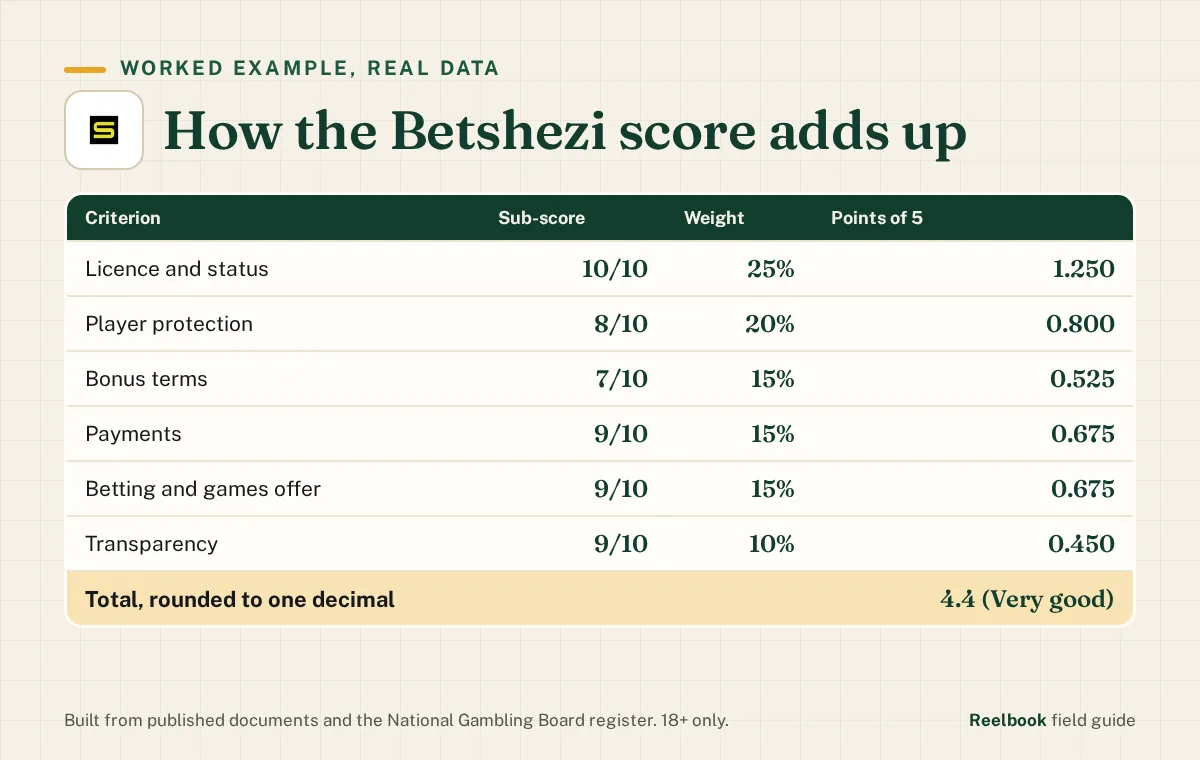
Worked example from a real scorecard
The highest-scored bookmaker on our file at the time of writing, with each sub-score multiplied by its weight and halved. The total is rounded to one decimal at the end, never at each step.
What the score words mean
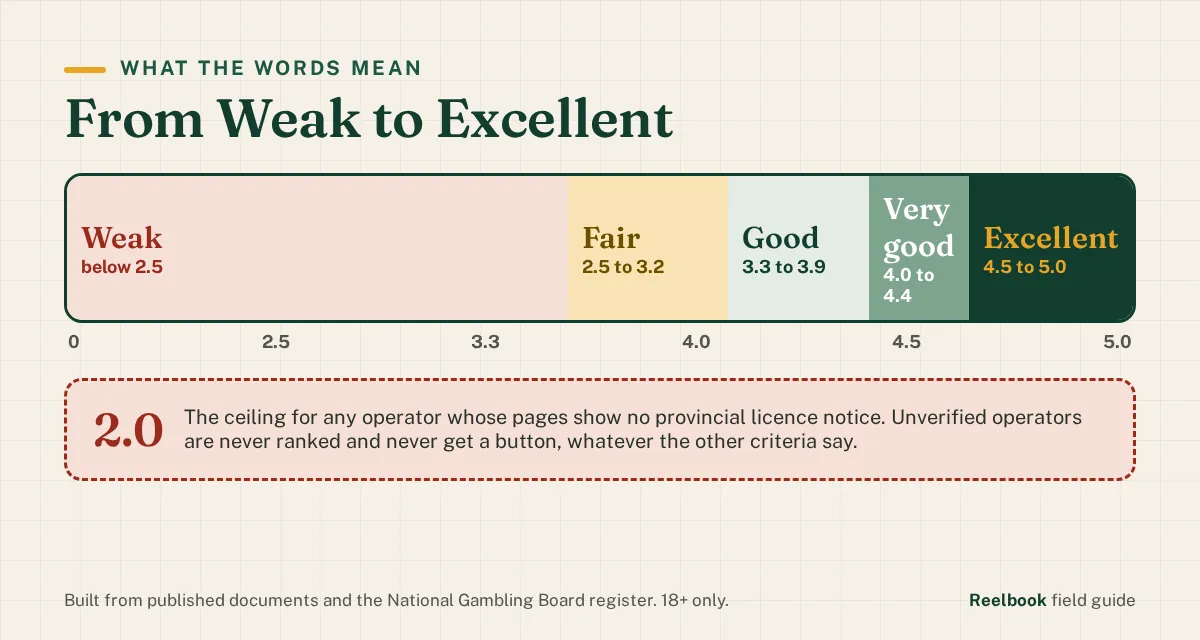
A word goes with every score so that small differences are not over-read. A 3.6 and a 3.8 are both Good; the gap between them is usually one criterion where one operator publishes a little more.
- 4.5 to 5.0: Excellent
- 4.0 to 4.4: Very good
- 3.3 to 3.9: Good
- 2.5 to 3.2: Fair
- below 2.5: Weak
A lower score does not always mean a worse bookmaker. Often it means the operator publishes less: if the terms that were read do not state payout times or bonus rules, the matching criterion cannot earn full marks. Each review says which facts were missing, so you can ask the operator directly.
How today's scores are spread
- Excellent4.5+0none at present
- Very good4.0+8Betshezi 4.4, Scorebet 4.2, SunBet 4.1, Sportingbet 4.0, World Sports Betting 4.0, Gbets 4.0, LottoStar 4.0, PlayBet 4.0
- Good3.3+8Betfred 3.8, Topbet 3.8, Bettabets 3.8, YesPlay 3.7, Vegas Bets 3.7, Supabets 3.6, TAB 3.6, Bet.co.za 3.4
- Fair2.5+8Playabets 3.2, Interbet 3.2, Betway 3.1, Hollywoodbets 3.1, 10bet 3.1, Easybet 3.1, Lulabet 3.1, Jabula Bets 3.1
- Weakbelow 2.50none at present
Sources: documents, not test accounts
Scores come from what an operator publishes and what regulators list: terms and conditions, bonus rules, help centre pages, app store pages, footer licence notices, provincial board lists and the National Gambling Board register. The editors do not open accounts, deposit or play. That keeps every mark checkable by a reader who opens the same pages, and it means a review can be wrong only in ways a reader can point out with a link.
Every fact behind a mark is stored with a short quote and the address it came from. When a page could not be read, for example because the operator's site refused automated reading or returned an error, the review says so rather than filling the gap.
Unverified operators
A brand whose pages show no licence notice that can be matched to a provincial board is marked unverified. Its score is capped at 2.0, it never appears in a ranking and it never gets a button. If it has a review, the review says plainly that no licence notice was found. Offshore casino sites are not reviewed at all, because online casinos cannot be licensed in South Africa.
A licensed brand that has stopped trading under its own name is treated the same way for rankings: Betting World, which now trades as Betfred South Africa, keeps a review that explains the change but has no ranking place and no button.
When scores change
Terms, bonuses and payment lists change often. When a document changes, the criterion is re-marked and the score recalculated. The date on each page shows when it was last checked. Operators cannot ask for a higher score; they can only publish clearer documents, which we then read like any other.
Gambling is for people aged 18 and over. Help is on the responsible gambling page, and the full list of scored operators is in the reviews section and the licensed betting sites ranking.
Questions and answers
Why is licence weighted highest?
Because betting is legal online in South Africa only with a provincially licensed bookmaker. Everything else matters less if that is missing.
Can an operator ask for a higher score?
It can send corrected documents. A score moves only when a published document supports the change.
Are bonus sizes part of the score?
Not the size. The bonus terms criterion rewards clear, complete rules, not big headline numbers.
Can I check a score myself?
Yes. The calculator on this page loads any bookmaker's real sub-scores with the same weights the reviews use, so you can rebuild the number and see what one changed mark would do.