
Guide
Gambling Tax in South Africa: Are Betting Winnings Taxed?
What published tax guidance says about betting and Lotto winnings in South Africa, why the 15% withholding rule never started, the taxes operators pay and the proposed 20% online levy.

Gambling tax in South Africa is mostly paid by the bookmakers, not by the punters. Published tax guidance says winnings from occasional betting and the Lotto are generally treated as windfalls rather than income, so casual players are usually not taxed on them, while people who bet as a business may be. We found no SARS ruling that covers every case, so treat this page as a summary of what sources say and check your own position with SARS or a registered tax practitioner.
Below: what the published sources actually say, the 15% withholding tax that was proposed and never started, the taxes operators pay, the national 20% online levy proposed for the February 2027 Budget, and the records worth keeping.
Where things stand
- Casual punters: tax advisers describe winnings as windfalls, generally not taxed. No SARS ruling found.
- Professional gamblers: profits may be taxed as business income.
- 15% over R25,000: proposed in 2011, described by Deloitte as never implemented.
- Operators: pay provincial tax on gross gambling revenue. A national 20% levy is proposed, not law.
- Your situation: ask SARS or a registered tax practitioner, especially for large or regular wins.
What published guidance says about betting winnings
There is no single SARS page on betting winnings that we could find, so the picture comes from tax advisers and from the Income Tax Act itself. The sources agree on the general position for casual players; none of them is a binding ruling for your case.
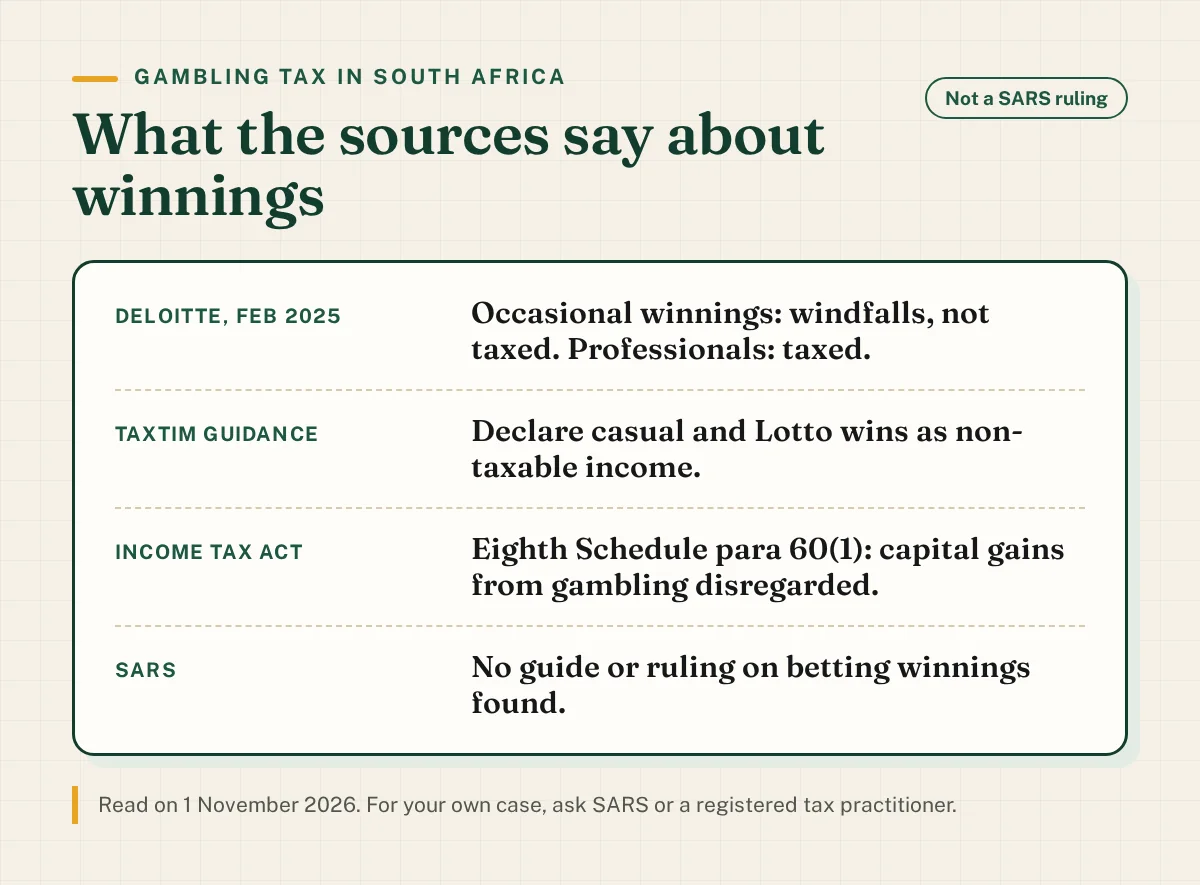
- Deloitte, February 2025 The firm's tax team wrote that winnings of occasional gamblers are exempt from income tax because they are classified as windfall gains, and that professional gamblers are taxed. This is an adviser's summary, not a SARS publication.
- TaxTim guidance The tax-return service says casual and Lotto winnings are not taxable but should be declared on the return as non-taxable income. The guidance dates from 2019.
- Income Tax Act, Eighth Schedule Paragraph 60(1) disregards capital gains from "any form of gambling, game or competition". Paragraph 60(2) has exceptions, believed to concern foreign or unlawful gambling; we could not confirm their wording.
We found no SARS guide or ruling on betting winnings when this page was checked. That gap is the main reason to take advice on any large or regular win, rather than rely on an adviser's summary or a forum post.
Windfall or income: where the line falls
Income tax applies to amounts earned from work, trade or investment. A one-off win on the Durban July or a lucky multi is not earned in that sense, which is why advisers call it a windfall. The position can change when betting looks like a business: regular, organised, profit-seeking activity, perhaps with systems, records and betting as the main source of money. Then the profits may be taxed like other business income.
Points towards a windfall
- Occasional bets for entertainment.
- Most of your money comes from a job or other income.
- No organised system or business set-up behind the betting.
Points towards taxable income
- Betting is your main or regular source of money.
- You bet in an organised, business-like way over a long period.
- You present yourself or operate as a professional gambler.
There is no published threshold that moves you from one side to the other. Where the facts are mixed, a registered tax practitioner can look at your actual pattern of betting and advise how to treat it.
The 15% withholding tax on winnings over R25,000
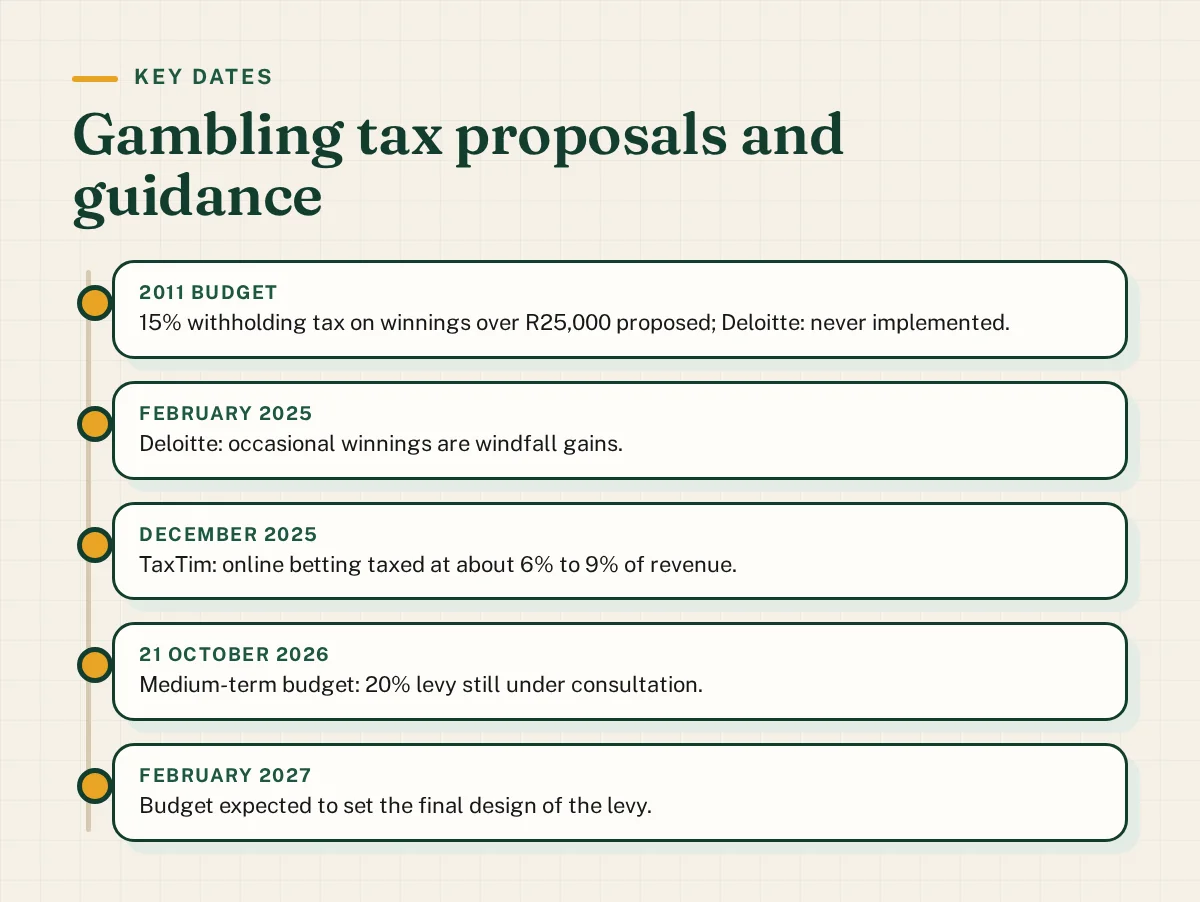
Many pages still say that winnings above R25,000 are taxed at 15%. That figure comes from a proposal in the 2011 Budget for a withholding tax on gambling winnings. According to Deloitte's 2025 note, it was never implemented, and we found no SARS source showing it in force. Pages that describe it as current are out of date or unverified.
Taxes bookmakers and operators pay
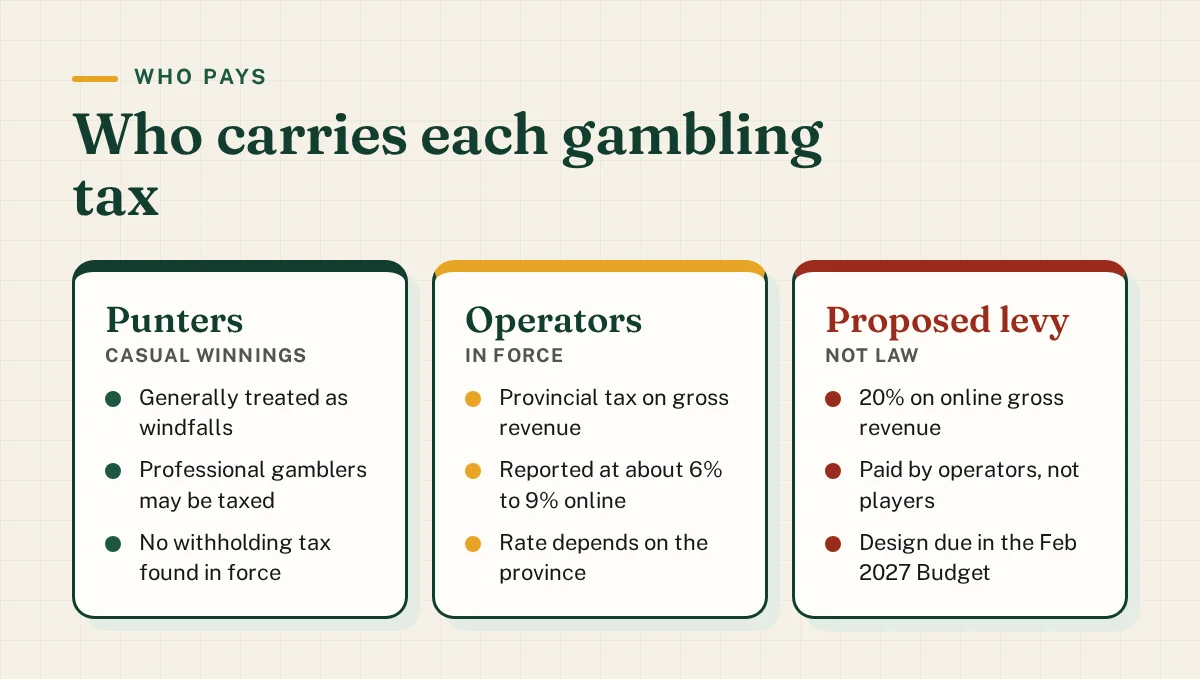
South Africa taxes gambling businesses rather than their customers. Each province levies tax on gross gambling revenue, the amount operators keep after paying out winnings. TaxTim reported in December 2025 that rates for online betting are roughly 6% to 9% of gross gambling revenue depending on the province. Exact rates for individual provinces should be taken from the provincial board or the provincial tax act, as we could not confirm them all from primary sources.
The proposed 20% national online gambling tax
National Treasury has proposed a 20% tax on online gambling, charged on operators' gross gambling revenue on top of provincial tax. TaxTim's explainer says it "does not apply to your personal winnings". At the Medium-Term Budget Policy Statement on 21 October 2026, the Finance Minister said consultations continue and that the final design will come with the February 2027 Budget.
Until the Budget and any law that follows, nothing changes for punters. A levy on operators could still affect you indirectly, through prices, promotions or which bookmakers stay in the market, but that is speculation until the design is published.
Common claims about betting tax, checked
Search results and social media repeat a handful of claims about gambling tax. Here is how each one compares with the sources on this page.
| Claim you may read | What the sources show |
|---|---|
| "SARS takes 15% of wins over R25,000" | A 2011 proposal; Deloitte says it was never implemented |
| "The new 20% tax comes off your winnings" | As reported, a levy on operators' revenue, not on players; still a proposal |
| "Betting wins never need to be declared" | TaxTim's guidance is to declare casual wins as non-taxable income |
| "Professional gamblers pay no tax either" | Advisers say profits from betting as a business may be taxed |
| "Your bookmaker deducts tax before paying out" | No source we read describes a deduction from player winnings |
Records worth keeping if you win
Whatever the tax position, a large deposit into your bank account is easier to explain with paperwork. These steps cost nothing.
- Keep your bet history. Download or screenshot the settled bet and the withdrawal from your bookmaker's account, with dates and references.
- Keep the bank trail. The withdrawal should land in an account in your own name; bookmakers often ask for proof of the bank account they pay into.
- Note the source. Which licensed bookmaker, which bet, which date. For a National Lottery prize, keep the claim documents.
- Ask before filing. For a large or regular win, ask SARS or a registered tax practitioner how to show it on your return.
National Lottery prizes and tax
Lotto and PowerBall prizes are covered by the same published guidance as betting: TaxTim describes Lotto winnings as not taxable but says they should be declared as non-taxable income, and Deloitte groups lottery wins with other windfalls. We found no SARS ruling specific to National Lottery prizes. How large prizes are claimed and paid is set by the operator, Sizekhaya, so check its site for the claim process rather than relying on older pages that describe the previous operator.
Questions to take to a tax practitioner
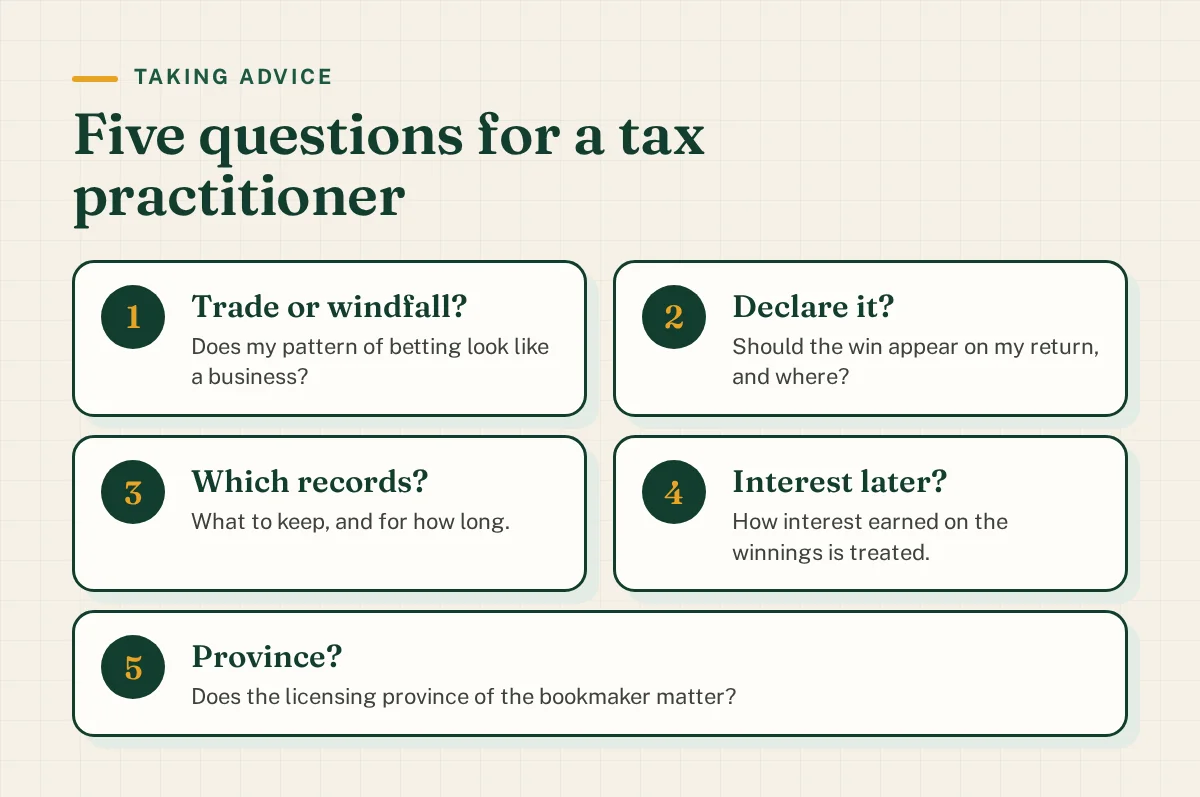
If a win is large, or betting is a regular part of your finances, a short consultation is cheaper than a dispute later. These are the questions worth asking.
- Does my pattern of betting look like a trade, or like occasional windfalls?
- Should the win appear on my return, and under which heading?
- What records should I keep, and for how long?
- Is interest earned on the winnings afterwards taxed as ordinary income?
- Does it matter which province licensed the bookmaker that paid me?
FICA, source of funds and the tax question
Licensed bookmakers are accountable institutions under the Financial Intelligence Centre Act. They verify your identity, usually with an ID document, proof of address and proof of bank account, and some ask about the source of funds for larger deposits. That is anti-money-laundering compliance, not tax, and it is not a sign that SARS is taxing your winnings. It does mean the bookmaker holds a record of who you are and what you deposited.
Licensed bookmakers, offshore sites and tax
Provincial tax, FICA checks and consumer protection apply to bookmakers licensed by a provincial gambling board. Offshore and unlicensed sites are illegal in South Africa, and the capital gains exceptions mentioned above are believed to cover unlawful gambling, so winnings from such sites may not be treated the same way. Our page on licensed betting sites shows how to check a licence, and the Lotto payouts page covers National Lottery prizes.
When tax is the least of the worries
Losses are not deductible for a casual punter, so money lost on betting is simply gone. Betting is for adults aged 18 and over; set a monthly budget, use the deposit limits licensed bookmakers provide and keep your bet history as a record of what you staked. If betting is costing more than you planned, our responsible gambling page lists confidential help.
Questions and answers
Do I pay tax on betting winnings in South Africa?
Published guidance from tax advisers says occasional punters' winnings are generally treated as windfalls and not taxed as income, while people who bet as a business may be taxed on profits. We found no SARS ruling that settles every case, so check your own position with SARS or a registered tax practitioner.
Is there a 15% tax on gambling winnings over R25,000?
A 15% withholding tax on winnings above R25,000 was proposed in the 2011 Budget. Deloitte wrote in 2025 that it was never implemented. We found no SARS source showing it in force, so do not rely on pages that describe it as current.
Do I have to declare Lotto or betting winnings to SARS?
TaxTim's guidance is to declare casual and Lotto winnings as non-taxable income. Whether and where to declare depends on your return, so ask SARS or a tax practitioner if the amount is large.
Will the proposed 20% online gambling tax affect my winnings?
As reported, it would be paid by operators on their gross gambling revenue, on top of provincial tax, and not by players. It is a proposal only; the Finance Minister said on 21 October 2026 that the final design comes with the February 2027 Budget.
Can I deduct betting losses from my tax?
Tax guidance does not treat a casual punter's losses as deductible. Someone taxed as a professional gambler would deal with profits and losses as business figures, and that needs a tax practitioner's advice.
Why does my bookmaker ask where my money comes from?
Licensed bookmakers are accountable institutions under the Financial Intelligence Centre Act, so they verify identity and may ask about the source of funds. That is anti-money-laundering compliance, not a tax.
Are winnings from an offshore betting site treated the same way?
That is not settled in any source we read. Offshore and unlicensed sites are illegal in South Africa, and the capital gains rules contain exceptions believed to cover unlawful gambling. Take advice rather than assume.