
Guide
Betting Strategy: Staking, Value and the Limits of Every System
What a betting strategy can and cannot do: the margin in every price, value, arbitrage, popular odds systems, losing runs, and staking that keeps betting inside a budget.

A sound betting strategy is about control, not a promise of profit. No betting strategy can promise winnings, because every price a bookmaker offers already includes its margin and results are uncertain. What a strategy can do is stop you overpaying for bets, keep each stake small compared with a budget you can afford to lose, and help you judge whether a price is fair.
This guide explains the margin first, because everything else depends on it, then value, arbitrage and the popular odds systems, and finally the part that matters most: losing runs and how to size stakes so they do not empty your budget.
What holds up
- The margin is in every price. A typical soccer market adds up to around 105%, so the bookmaker expects to win over time.
- Value means a price longer than the real chance. It depends entirely on how good your estimate is.
- Losing runs are normal. At odds of 2.00, five losses in a row will very likely happen within 100 bets.
- Stake small and flat: 1% to 2% of a monthly budget per bet, and stop when the budget is gone.
Why the margin decides every betting strategy
Divide 1 by the decimal odds to get the implied probability. On a match priced 2.10 home, 3.30 draw and 3.60 away, the three implied chances add up to 105.7%. The 5.7 points above 100% are the margin: the bookmaker's edge whatever the result. A betting strategy that ignores it is betting with a small handicap on every slip.
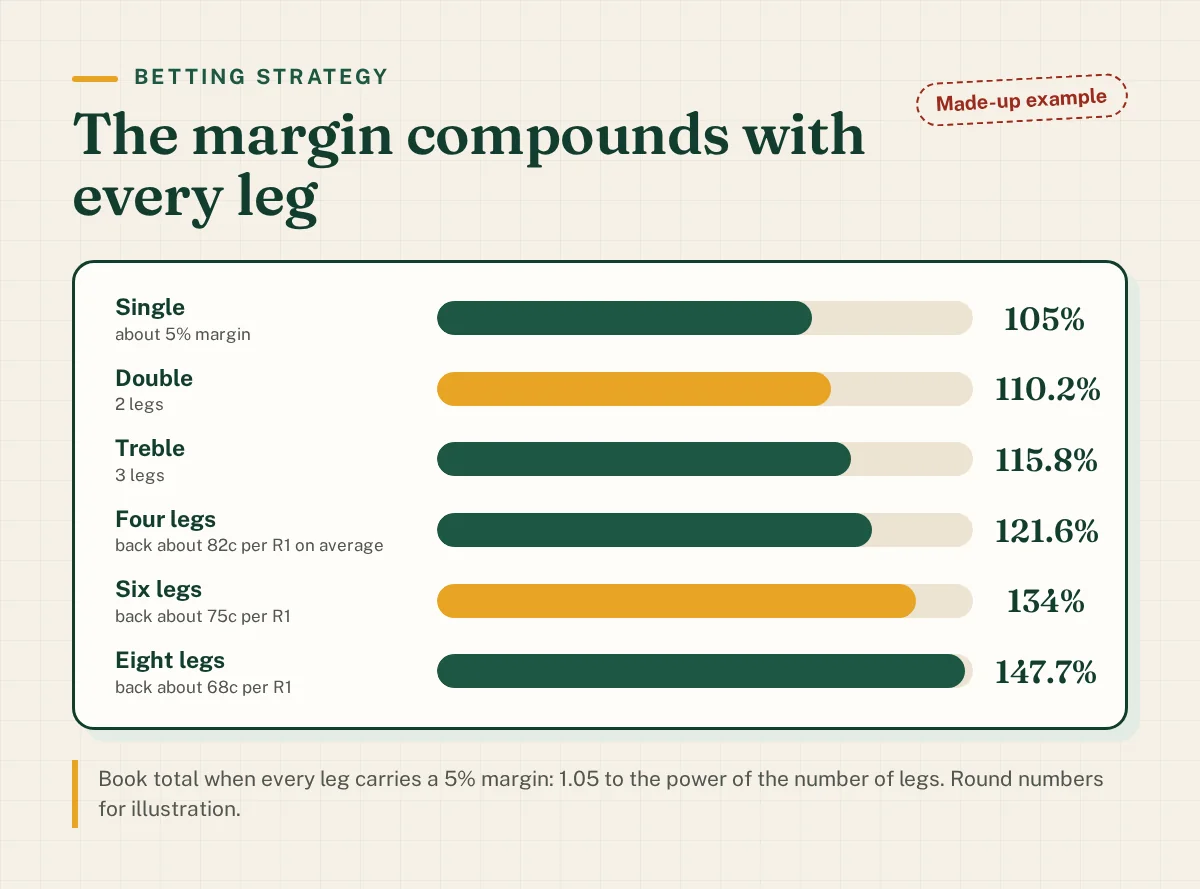
The margin grows when you combine selections, because the odds multiply and so does the edge. If each leg carries about 5%, a four-leg multi carries about 22%, and an eight-leg slip about 48%.
Two practical steps follow. First, compare prices for the same selection at two or three licensed bookmakers before you bet; the betting odds comparison explains how. Second, keep multis short. Our odds calculator shows the margin of any market if you enter the price of every outcome.
Value betting, honestly explained
Value betting means backing an outcome only when you believe its real chance is higher than the price implies. If you rate a team at 55% and the odds are 2.10 (47.6% implied), the price is longer than your estimate says it should be. At 1.70 (58.8% implied) it is not, even though the team is the same favourite.
Everything rests on the estimate. A "value bet of the day" from a tips channel or a value bet finder app is only as good as the model behind it, and few publish a full record. A value bet calculator only does the division above; the judgement is still yours. The honest test is a written record: your estimate, the price you took, the stake and the result for every bet. After a few hundred bets it tells you more about your judgement than any tipster.
Arbitrage betting and why it rarely lasts
Sports betting arbitrage uses different prices at different bookmakers so that every outcome is covered and the total stake returns slightly more whatever happens. It only exists when the best prices across bookmakers imply less than 100% in total.
| Step | Made-up two-way example |
|---|---|
| Best price on side A | 2.15 at one bookmaker (46.5% implied) |
| Best price on side B | 2.05 at another (48.8% implied) |
| Total implied | 95.3%, a gap of about 4.7% |
| Stakes on R1,000 in total | about R488 on A and R512 on B |
| Return either way | about R1,049 |
In practice the gaps are small and close within minutes. If one price changes before your second bet goes on, you are left with an ordinary one-sided bet. Bookmakers can void bets placed at obvious pricing errors under their terms and can limit accounts. An arbitrage betting app or finder shows gaps; it does not remove those risks, and the amounts tied up are large next to the return.
The 2 odds and 1.10 odds systems
Both systems feel safe because they win often. The arithmetic says otherwise.
- The 1.10 odds strategy Heavy favourites at very short prices. At 1.10 the break-even rate is 91% before any margin: lose one bet in ten and the run is back to zero. Upsets at short prices happen every weekend.
- The 2 odds betting strategy A single or small multi at about 2.00 every day, often rolling the winnings over. Rolling R100 for ten days would need ten wins in a row; at a fair-looking 47.6% chance each, that happens about 6 times in 10,000 tries.
Rolling stakes over is the part that does the damage. Each new bet carries the whole pot, so the more often the system wins, the more is lost when it finally does not.
Losing runs: what to expect at the odds you take
Most people underestimate how long losing runs get. At odds of 2.00 with a 5% margin, the chance of losing any single bet is about 52%. Over 100 bets, a run of five losses in a row is very likely, about 87%, and a run of eight happens in roughly one 100-bet stretch out of four.
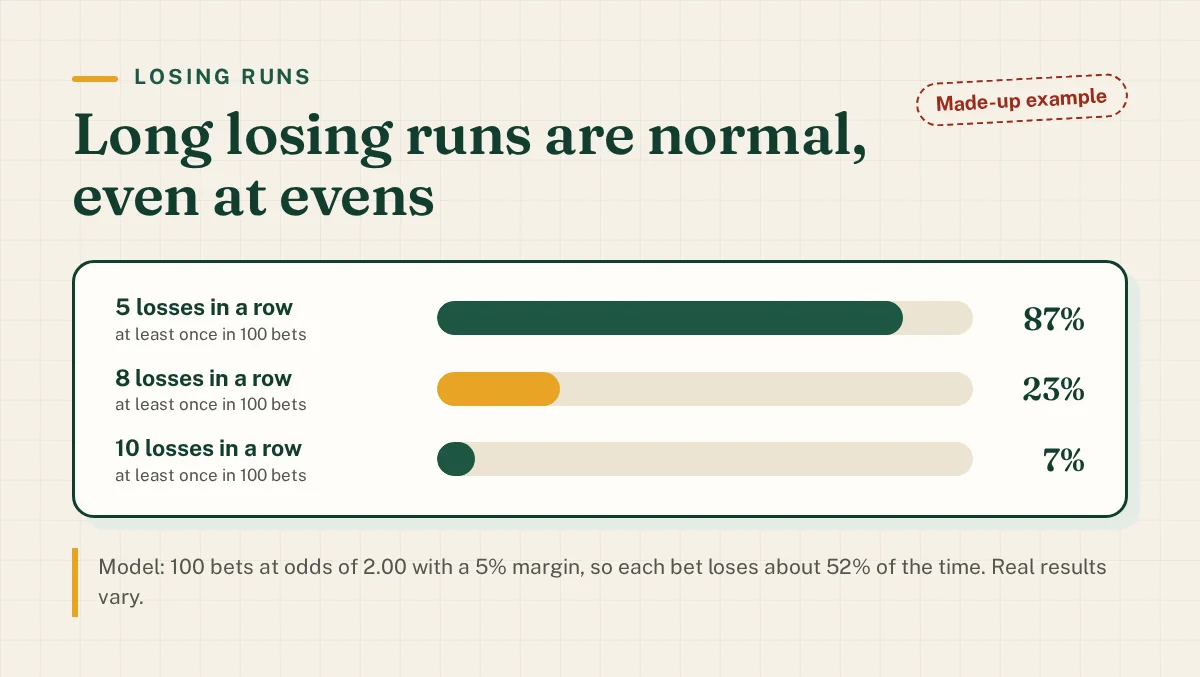
That is why staking matters more than picking. The planner below takes the amount you can afford to lose this month and your stake size, and shows how many losing bets in a row the budget covers, how likely such runs are at your usual odds and the loss the margin implies over 100 bets.
Budget and losing-run planner
Set the money you can afford to lose this month and a stake size. The planner shows how long that budget lasts in a bad run and how likely such a run is at the odds you usually take.
- Stake per bet
- -
- Losing bets in a row the budget covers
- -
- Chance the next 5 bets all lose
- -
- Chance the next 10 bets all lose
- -
- Expected loss over 100 bets
- -
A model with a fixed chance per bet: real results vary. The expected loss is the margin you enter times the money staked; no staking plan removes it. If the budget is gone, stop for the month. 18+ only. Betting can lead to losses and addiction, so set a budget before you start. Responsible gambling.
Staking plans compared
A staking plan decides how much goes on each bet. Three are common; only one is suitable for most people.
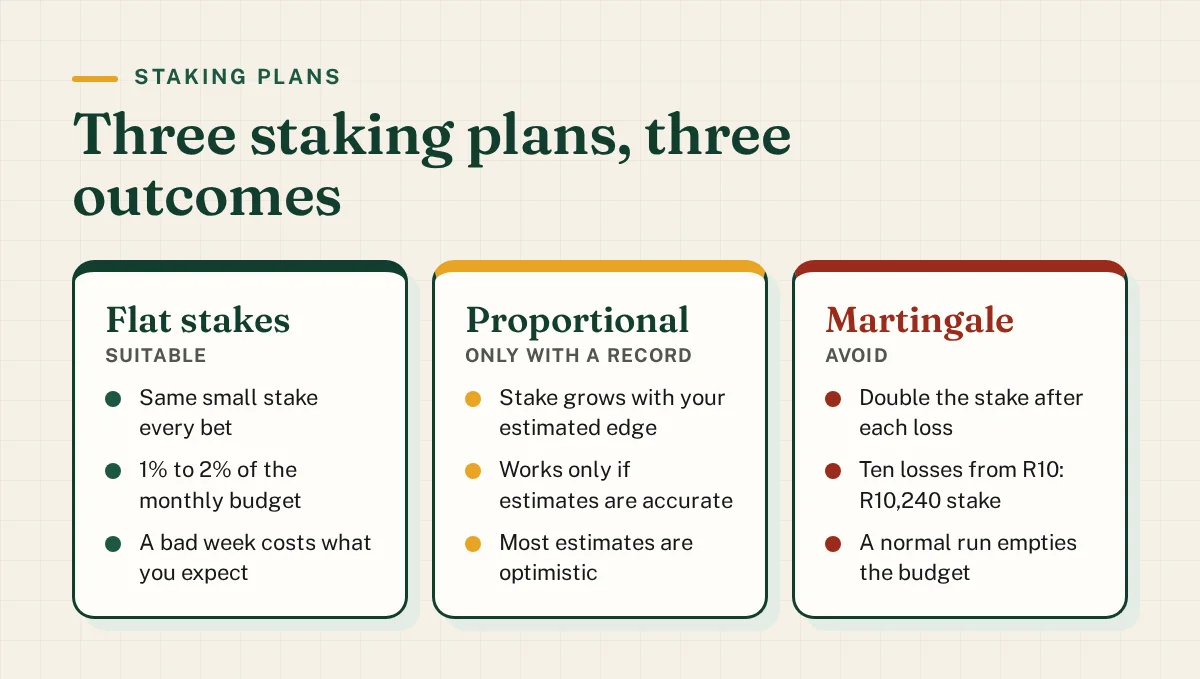
- Flat staking: the same small amount on every bet, such as 1% to 2% of the monthly budget. Losses come slowly and predictably, and you always know what a bad week costs.
- Proportional staking (Kelly-style): a stake that grows with your estimated edge. Efficient on paper if your estimates are right, and punishing when they are not; most estimates are less accurate than they feel.
- Martingale: doubling after every loss to win back what was lost. Ten losses in a row from R10 means a stake of R10,240. It turns a normal losing run into a lost budget. Avoid it.
Football betting strategy that stays realistic
A sensible football betting strategy is narrow rather than clever. Follow one league closely, such as the Betway Premiership, and you may read team news, fixture congestion and travel better than a price set alongside hundreds of other matches. Even then, keep to a few markets you understand, compare prices before every bet, and prefer singles to long multis. Our guide on how to bet explains the main soccer markets.
A plan can
- Stop you paying more margin than you need to.
- Keep stakes small enough to live through losing runs.
- Give you a written record to judge your own decisions.
- Set a point where you stop for the month.
No plan can
- Remove the margin from the bookmaker's prices.
- Make a random result predictable.
- Win back losses by betting more.
- Turn betting into a reliable income.
Keeping a betting record that tells the truth
The most useful tool in any betting strategy is a plain record, kept for every bet, including the small ones and the ones you would rather forget. Memory keeps the wins and drops the losses; a spreadsheet does not. Your bookmaker's bet history holds most of the data, but it will not hold your reasons.
| Column | Why it matters |
|---|---|
| Date, event and market | Shows which leagues and markets you actually bet on |
| Odds taken and stake | The total staked is the real cost of betting, not the losses you remember |
| Your estimated chance | Lets you check later whether your estimates were too optimistic |
| Best price elsewhere | Shows how much margin you could have avoided by comparing |
| Result and return | Profit or loss per market, per month, per bookmaker |
Review it once a month, not after every bet. If one market or one kind of multi keeps losing, drop it. If the monthly total staked keeps rising, that is a signal to lower the deposit limit, not to raise the stakes.
Games of chance have no strategy at all
Keno, lottery draws, slots and crash games are random. Picking more or fewer numbers, betting at a certain time or following "hot" numbers changes the shape of the payout, never the chance. Greyhound and horse racing at least have form to read, but the same margin and the same losing runs apply.
A budget comes before any betting strategy
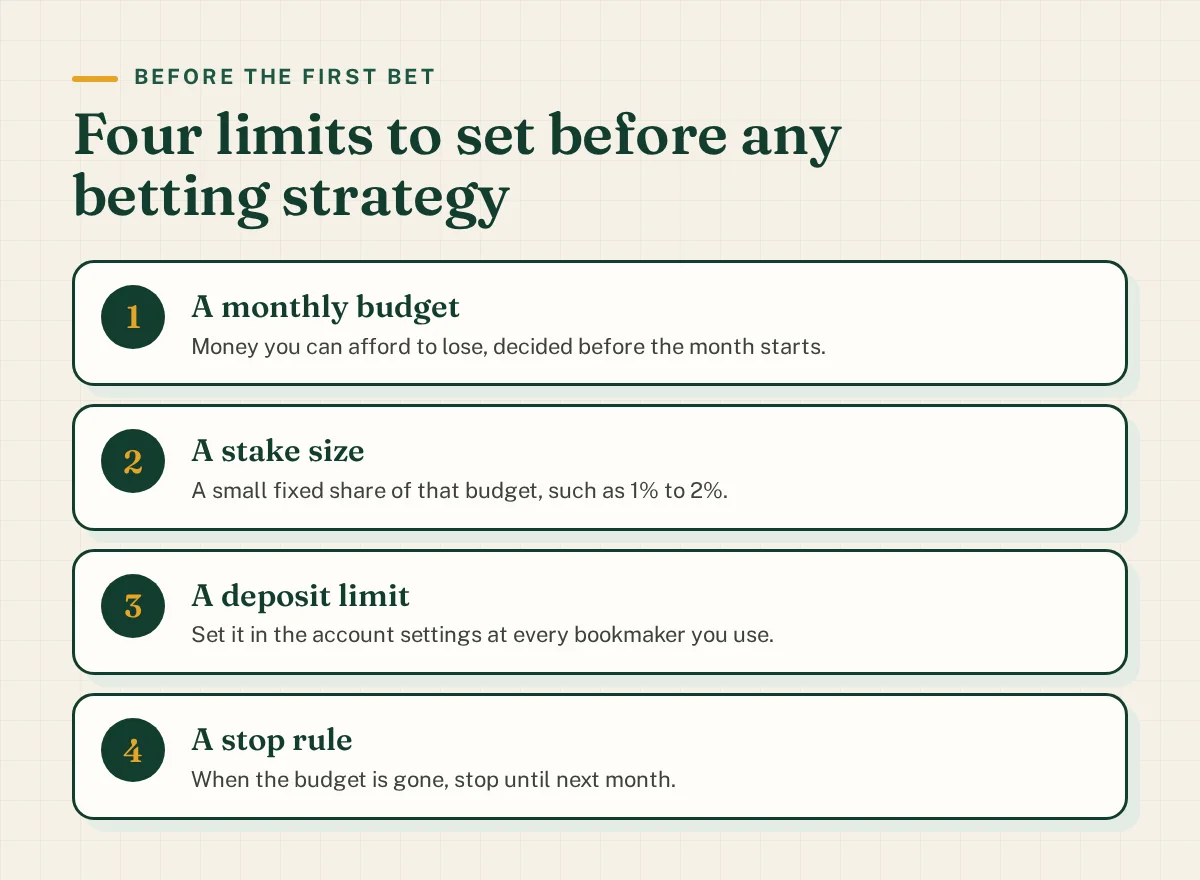
Betting is for adults 18 and over, and it is entertainment that costs money, not a way to earn or to win back losses. Decide a monthly amount you can afford to lose, set it as a deposit limit at every bookmaker you use, and stop when it is gone. If you find yourself chasing losses or betting more than you planned, the National Responsible Gambling Programme offers confidential counselling on 0800 006 008, and our responsible gambling page explains limits and self-exclusion.
Questions and answers
Is there a betting strategy that always wins?
No. Every price includes the bookmaker's margin and every result is uncertain. A strategy can stop you overpaying and keep stakes in proportion to a budget; it cannot promise a profit.
What is a value bet?
A bet where your honest estimate of the chance is higher than the probability the odds imply. It is only as good as your estimate, and even real value loses often in the short run.
Is arbitrage betting legal in South Africa?
Placing bets with licensed bookmakers is legal and no law bans covering every outcome. Bookmakers can limit accounts and void bets placed at obvious pricing errors under their own terms, which is the main practical risk.
Does the 1.10 odds strategy work?
It wins often but pays little. At 1.10 you must win more than 9 bets in 10 just to break even, before the margin, and one upset can cancel a long run of small wins.
What is the 2 odds betting strategy?
Backing a selection or a small multi at about 2.00 every day, often rolling the winnings into the next bet. Rolling over means the whole pot rides on every bet, so one loss ends the run.
How much should I stake per bet?
A small, fixed share of the money you can afford to lose this month, such as 1% to 2%. That keeps a normal losing run from emptying the budget in an afternoon.
Does the Martingale system work for betting?
No. Doubling after every loss needs ever larger stakes; ten losses in a row from R10 means a stake of R10,240, far beyond most budgets and many bookmakers' maximum bets.
Can betting be a way to make an income?
It should not be treated as one. The margin means bettors as a group lose over time, and treating betting as income or as a way to win back losses is a warning sign of problem gambling.